By Ivo Wakounig
Exactly two years ago I started my PhD at Eindhoven University of Technology. Being half-way through the four year long journey, it is again time to reflect and take stock of what has happened in the past year and how it has affected me personally. This article builds on another one published a year ago, where I reflect on my experience and learning trajectory in the first year (Access it here).
Learning by Doing and Doing by Learning
The second year has been quite different compared to the first. While the first year was about exploring and building foundations, the second was about implementing. Implementing means performing research, writing research articles, but also questioning the foundations I have build in the first year. When it comes to performing research, I organised interviews and workshops, and read numerous documents to gather qualitative data for my research projects. Furthermore, I had the privilege to disseminate my research at multiple fora, during which questions by and interactions with the audience helped sharpen my research approach. When it comes to writing articles, I managed to finish one in May (currently under review), and I am currently working on six different research projects, three as co-author in a larger research team and three as main author – aside from writing regular blog posts such as this one. As with questioning the foundations, the empirical work as well as further readings made me re-assess the theoretical and conceptual foundations I have built by laying a stronger focus on more foundational theoretical approaches. One practical example would be my move from policy feedback theory towards historical institutionalism as a central theory for the upcoming projects.
In the second year I have performed more practical tasks, which have taught me various skills relevant for my research. I have strengthened my ability in structuring, ideating, and conducting qualitative research. Since the past months I notice that I read others’ work in a different, more critical and simultaneously appreciative way. As a side effect, I often struggle to separate my academic thinking from non-academic writing, as I feel the urge to put thoughts and texts in academic structures, which is often inappropriate for such types of work. This, to me, is a marker that I still need to refine my academic thinking, as I need to understand how and when (not) to do it. Simultaneously, my writing skills have improved significantly, mainly because of writing various texts, reading numerous publications, and rejecting artificial intelligence to manicure my manuscripts. As someone who has struggled with English language in school, improving my English writing is something which I am somewhat proud of. However, there is still a lot of room for improvement, for example when it comes to metaphorical writing or storytelling.
No end at the Horizon
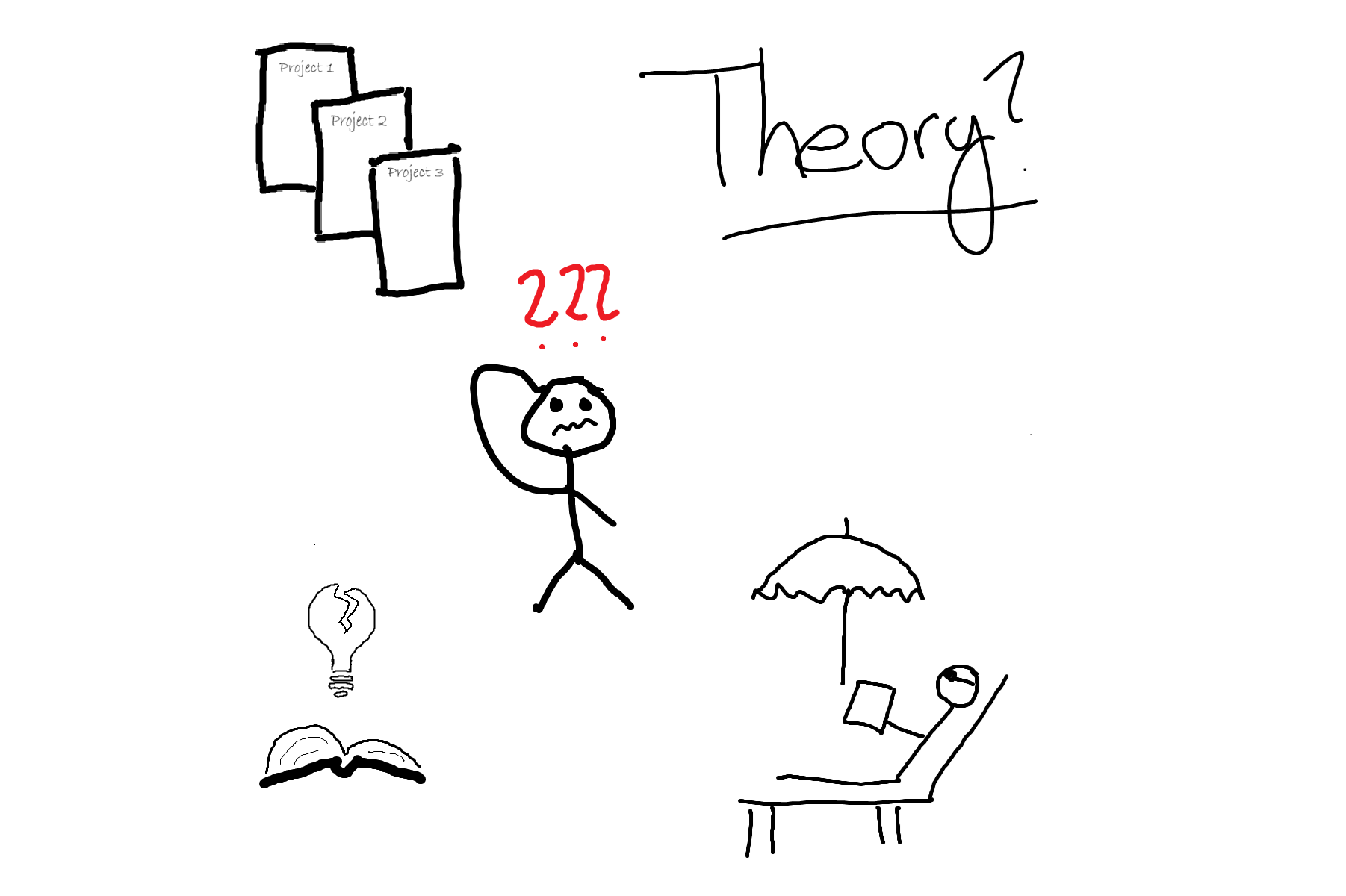
Reflecting, the past year(s) have been formative and developed my skills and myself further. Based on conversations with peers and reading some articles in the field of mental health concerns in academia, the upcoming one to one and a half years will be the most challenging in my PhD trajectory. I personally coin this period the PhD valley of uncertainty, wherein researchers are squeezed between a reduction of the initial euphoria and a quickly approaching end of journey, coupled with rejections of articles or major revisions, taking weeks and months to implement. A few struggles which I currently face are reading procrastination, the omnipresent confusion about my final result, and finding the courage to take breaks.
- Reading procrastination: This refers to the mindless reading of documents or articles which are not really relevant for my work, aiming to find a needle in the hay which I didn’t want to find in the first place. This is often the result of not having the mental energy to write, because my creative energy has been exhausted or some thoughts need some more time to ferment. While I am aware that this is part of the research process and a direct result of perfectionism and the need to overperform, going beyond these tensions is nevertheless quite challenging.
- Omnipresent confusion about my final thesis: A concern which haunts me throughout is the omnipresent confusion about which shape or form my final thesis will take. I do see an increase in this confusion the further I am in the process and the more I approach the end (which is still far way). While there is clarity regarding the topics and themes, the exact storyline and how the different theories and concepts may (not) fit together remains a concern. The continuous worry is that certain directions of research may lead to an incongruent thesis, failing to meet the expectations of the promotion committee. This is a common emotion among PhD researchers and may be part of the process, which can serve both discourage and motivate to continue working on the thesis.
- Courage to take breaks: Building on the previous two worries, another one is the courage to take breaks. As there is the omnipresent voice pushing to read and write more, taking breaks is more challenging than one can imagine. Taking breaks elicits a feeling of guilt and failure, as the time could have spent on progressing the research or reading more articles (looking at reading procrastination here). While I could overtheorise this point and locate the source of this concern in our neoliberal capitalist hyperoptimised way of working and thinking, I strongly believe that academia is an environment where such emotions thrive. A colleague once told me that the beauty of academia is that it counts as progress when you only think about your work, which has helped me cope with feelings of guilt when taking breaks ever since. Furthermore, the acknowledgement that breaks are a critical component of progressing my (academic) work has significantly helped me in coping with these tensions.
As I can learn from peers in how to overcome those challenges and I am embedded in a supportive academic environment, I am confident that I will be able to navigate through the PhD valley of uncertainty by growing personally as well as academically.
Looking Forward may be Clearer than it Feels
Despite the uncertainties and struggles, there is nevertheless some clarity on the road ahead. Empirically the route has been set, focusing on energy transitions in the Netherlands in offshore wind, hydrogen in its broadest sense, and potentially jobs & skills. All topics are highly relevant and broadly debated in policy and political circles. Hence, my research is not only timely but also highly relevant, as it can inform decisions impacting the Dutch energy future.
Theoretically and conceptually, in the upcoming years I will further my research in the domain of historical institutionalism and policy feedback theory, as this can inform how structures such as energy systems can be changed. I aim to connect said strands of literature with lock-in literature to fully grasp the mechanisms which enable and constrain transformative change in the (Dutch) energy system.
An activity which clarifies the way ahead and which serves as a beacon of stability and support are my ongoing activities at the Future Energy Leaders the Netherlands, as my activities there support my research in various aspects, such as networks, content, and context. Being engaged in Dutch energy transition dialogues through my position as a co-chair of this network enhances by understanding of the transition dynamics and which stakeholders are relevant for realising change. In the upcoming months and years I will find ways to connect those activities stronger with my research, so that both activities can profit from each other.
Join me in my Journey through the PhD Valley of Uncertainty!
As I embark on the second half of my PhD, I would be more than elated if some of you can share your own experiences and how you perceived the second half of the PhD journey. Also, let me know in the comments what you think of the above!
Leave a Reply