By Ivo Wakounig
With finishing the third year of my PhD at Eindhoven University Technology, I am now entering the fourth and final year of my PhD journey. I use the term journey rather carefully as the past three years seem like an amalgamation of different experiences and lessons which may (not) fall under the common understanding of journey or progress. As I have done in year one and two, I would like to use this moment to reflect and introspect so that others understand what has kept me busy in the past months.
Doing research is like exercising
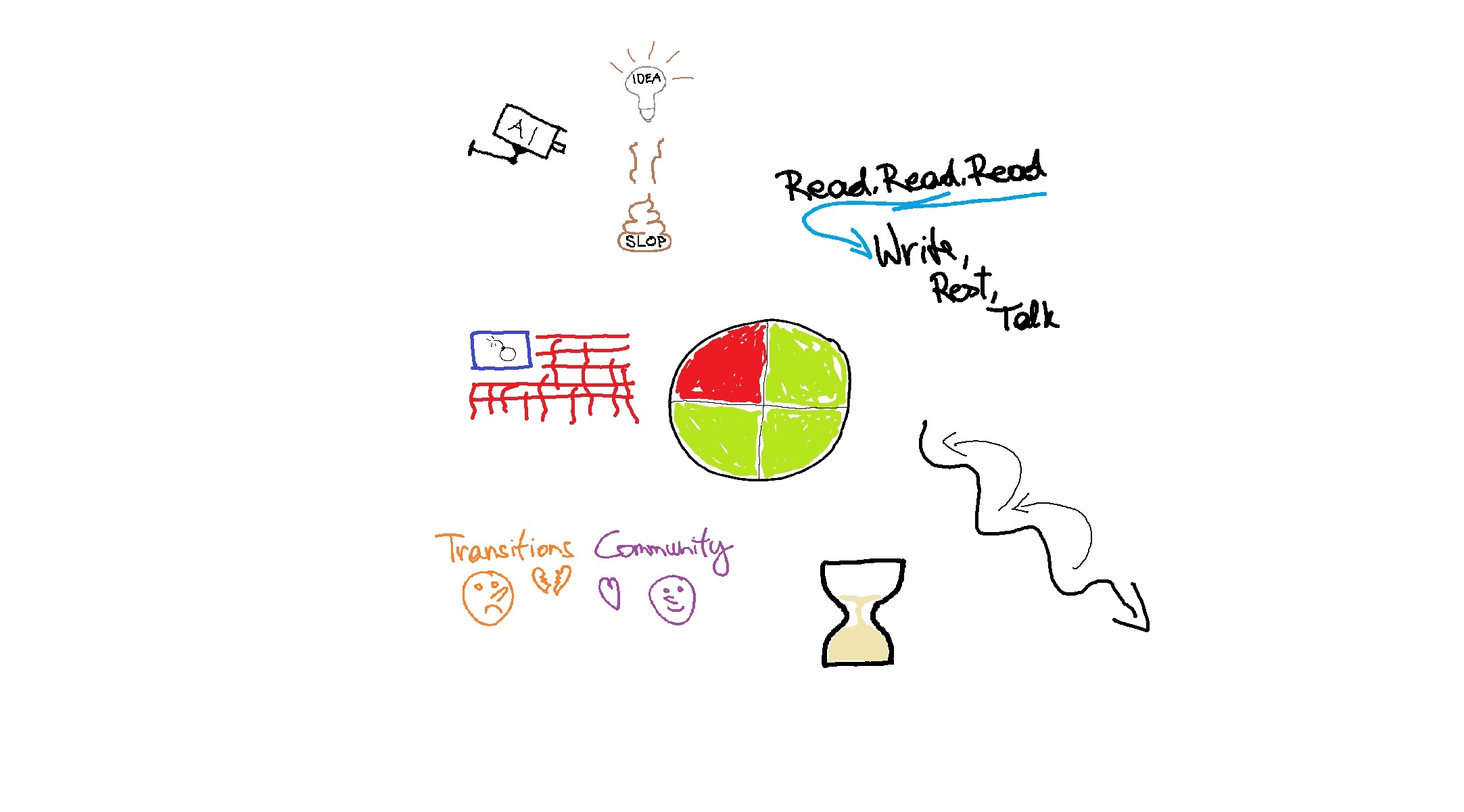
An important lesson which I learned in the past year is that doing research feels like exercising. Be it running or going to the gym, exercising works best when done in a routine, such as a certain number of times per week. This regularity coupled with some pre-determined flow or sequence of moves can, over the stretch of a few months, lead to visible progress. At some point, this progress can become addictive, as you see that you can suddenly run greater lengths. So, to get even better, you start putting in more exercises and time into your routine, at the expense of rest. All works well until, at some point, you stall. This is the point where prudent decisions have to be made.
In research and in exercising, when you stall, you should start reflecting on the process, do something alongside the main routine, and take rest super seriously. However, this sounds very counterintuitive as it goes against what has worked in the months and years before. When faced with the decision either (a) to either keep pursuing a little bit more of what has worked really well before (but will likely not lead to success) or (b) to change behavioural routines, the intuitive reaction in most cases is to choose the option a.
When the progress in my research started to stall around one and a half year ago, I chose the first option too. It led to numerous issues, such as the feeling of being stuck, fatigue, and a general feeling of discontent. At some point, a colleague of mine told me that resting is as important as reading when you are doing a PhD, and this flipped my understanding. It was during the time when I felt stuck and was doing more of the same that I did not realise that what I was missing was a realignment in my approach.
In a gym, when you hit a plateau, you have to start doing complementary exercises and take more rest. This is also correct for research, and it was what I needed the most. As soon as I took conscious rest, distanced myself from my own research, and broadened my horizons, I started to see visible improvements in the approach to my topic. For example, I have learned more about industrial policy when reading Nikolai Bukharin’s Imperialism and World Economy than when reading the fifty millionth transitions article on that topic. That’s why researching often fells like exercising.
The end is approaching
Entering the fourth year makes it more tangible that the ‘end’ is approaching – that’s why we call it final year in the first place. The feeling of the PhD coming to an end has stuck with me over the past year, but approaching it confuses me more than it clarifies. There are these constant lingering questions whether I will make it in time, if I have worked sufficiently on the articles, what the final thesis may look like, what will happen afterwards, and what I should actually work on today. Sometimes it feels like being in a state of stasis, while at the same time I keep getting reassured by my environment that all is and will be fine. This disconnect between what I feel and others see lead to so much confusion.
What helps in these moments, at least sometimes, is reflecting about how my way of working has changed. While I am very aware of the need to take a step back (see earlier) and I am actually doing it, it feels wrong to do these things during a time when I am expected to put in the most work (that’s another source of confusion). These days, I spend much more time on targeted reading and writing, more so than at the beginning, which could be a sign that I have (finally?) gained focus. I also believe that I have become way better at shedding light on the important aspects in my research, which saves me immense time in the process. I also feel that I am learning way more these days than I did at the beginning and I have way more ideas and see more pathways to exploring something new in the field. This, again, could be a sign of being more targeted.
But the end is still approaching…
Some things disappointed me
The past months were unfortunately also a time of disappointment from an area I did not expect it to come from. I have been to quite some conferences in the past one and a half years, four of which are directly connected to the transitions community (two NEST, two IST conferences). This means that I engaged with the people and the institutional structures which give rise to and shape the academic field I feel (partially) embedded in. Unfortunately, this only contributed to my disappointment with the field, as I started to understand that articles find a beautiful language for thoughts which are faulty to begin with. It feels that large parts of the community remain confined to their naïve thinking and they refuse to take into account the wider political developments, international trade flows, colonialism, and so forth. I learned through my interactions with others that transitions is a field which manages to depoliticise politics and it has become very close to industry marketing lingo, essentially contributing to the problem it intends to solve. I also learned the hard way how Eurocentric and white the transitions community is. It is one thing to read about this in an article, but experiencing first-hand how whiteness dominates the community was truly shocking to me.
Another disappointment relates to how my very own university deals with the usage of Large Language Models (LLM) and Artificial Intelligence (AI) in teaching. At this point, most people should be aware that those technologies did not deliver the results which were promised to us by large digital technology companies. Even worse, we already see in our teaching how this technology negatively influences our students’ ability to learn and retain information. By encouraging the usage of AI in teaching and seeing those as an inevitable part of the future, Eindhoven University of Technology normalises the usage of AI in its teaching and, indirectly, even compels students to use it despite them not wanting to do so. The outsourcing of the brain and thinking to a machine during a time when students should develop their critical thinking is extremely disappointing to see. I often get the comment that ‘what else did I expect from Eindhoven’, but I find this argument to be cynical and defeatist. Precisely a technological university should remain highly critical of technologies and their impact on societies, instead of copying and pasting industry narratives onto their curricula under the pretence of doing something good for those.
Other things lifted me up
Luckily, not all things are bleak and terrible. To immediately respond to the disappointments in the above, in both cases I am part of groups and communities which would like to change the situation. These activities keep me motivated as they allow me to share my doubts but also explore ways out. They also keep me going, as I find a lot of energy and inspiration by collaborating with different people on such topics. I learn quite a bit in those processes, as they make me more critical and politically aware of how to organise around certain issues and finding common positions when exploring contentious topics. It helps quite a bit not finding yourself isolated in your critique but being surrounded by like-minded people.
Another thing which lifted me up was my first article finally being published. Woohoo! During the publication process, I learned so much about the academic publishing system – the good and the bad sides. For example, while it was terribly annoying to get rejected through AI generated reviews or having to deal with inconvincible reviewers, in hindsight, I feel grateful to have learned these lessons early on. I also managed to experience the good side of academic reviewing, which is constructive criticism attempting to improve the state of the manuscript. The article being out was a motivational boost which came perfect in time and lifted quite some pressure off my shoulders. Having an article published gives me more confidence in writing future ones and successfully navigating peer review processes. What I have also learned in that process is that publishing can be quite an addictive process, as the entire process is filled with uncertainty and surprises, only to be awarded with the release of dopamine when the article is finally published. However, this quickly leaves a void, which needs to be filled with yet another article. So, more articles coming soon?
I am getting concerned
Something which literally keeps me awake at night ever since the start of my PhD is the state of the world. I often have this sense of nervousness when opening the news in the morning, as the USA and its proxies may have committed yet another heinous war crime during the night. The explosive (quite literally) growth of wars across the globe have really affected my mental state and the things I care about or pay attention to. There is a sense of guilt that I, living in the imperial core, remain unaffected by the havoc the west lays upon the rest of the world. Even worse, the abysmal state of the world has even helped me in finding a better focus in my approach and I think that the quality and depth of my thinking has improved as a result of that. It feels disgusting to think that reading about and protesting against the genocide in Palestine helped my academic thinking, almost as if I would profit intellectually from children being bombed. As the global situation is escalating at an ever faster pace, the need to act gets ever more urgent. There are many moments where I feel that my position as a PhD is holding me back in taking meaningful action, for example because of the lack of time or energy, making be wonder whether I am making the (ethically) right choice pursuing a PhD. This leads to many concerns.
What lies ahead?
It is because of all those different tensions and confusions that it is very difficult for me to predict what lies ahead. I believe that the factors which will shape the next year the most will be geopolitical developments, personal matters, my contribution to different groups, and academic progress. I wish that there would be an end to the warmongering and destruction as well as the boundless growth of techno-fascism. But these wishes have to be actively implemented and not hoped for in an imagined world. I will, hence, use this platform (my website) more consciously to digest what is happening in this world and I hope that this can help others in making sense of the world. I will also increase my engagement with change communities in order to contribute to some of the transformations which the world so direly needs. Alongside, I hope that I can stay focused on the PhD and submit a meaningful thesis in time.
Leave a Reply