By Ivo Wakounig
Digital technologies are reshaping the world. Within the span of a few decades, large parts of the world gained access to the internet, computers, and smartphones. Early pioneers of the internet proclaimed that an internationally connected society will evolve to the better and grant every person access to all information immediately. Instead of starting a new age of enlightenment, the world has been put under a digital superstructure which is misused for malicious purposes.
Digital platforms are the current frontier of technological development and they contribute to a plethora of problems. Democracies are eroding in the West, our entire existence is increasingly commodified, and now we are getting buried by the AI boom. It is difficult to not feel despair in such moments as it seems that we are losing control over the technological developments which are forced onto us. A key player behind this feeling of despair are technology companies (from the USA), which are increasing their grip over our life by the day and eroding the foundations our societies build on.
These are very worrying times to live in. A book which helped me contextualise some of the current developments and gave me and many others a language to express the changing landscape is Yanis Varoufakis’ ‘Technofeudalism’. In this article, I will first summarise the key theses of his book and then attempt to interpret some of the contemporary events under that light. Despite the worries and tensions which the unbound technologisation raises, there are still many opportunities to change course and retake control over our collective future.
The Rise of Tech Companies
Before diving deeper into technofeudalism and its implications, it is important to understand which forces led to its emergence to adequately position it in the past, present, and future. Yanis Varoufakis traces the origins of technofeudalism to the financial crisis 2007/2008. The financial crisis erupted because Western financial systems went out of control and completely detached themselves from the real world. Flawed financial instruments and fraudulent bets reached unimaginable heights. In 2007, the value of financial speculation was 10 times higher than the value of the real economy. It is, hence, no surprise that once this hyper-inflated financial superstructure collapsed, the entire world economy went down with it.
In the years which followed the collapse, governments worldwide relied on a number of instruments to save the banks (not the people) in order to restore the financial system. In the USA and the Eurozone, the cash printing machines were activated and incomprehensible amounts of money were injected into the economy. Interest rates were reduced to 0%, meaning that money was essentially handed out for free for companies to invest in anything they could get a hold onto. This anything they could get a hold onto was in most cases real estate, art, football clubs, and share buybacks, none of which are productive investments. While corporates increased their property wealth, the real income for the population fell due to job losses, wage cuts, and assaults on their social systems. Yanis Varoufakis rightly terms this process ‘socialism for the bankers, austerity for the poor’, which increased income and wealth inequality substantially since then.
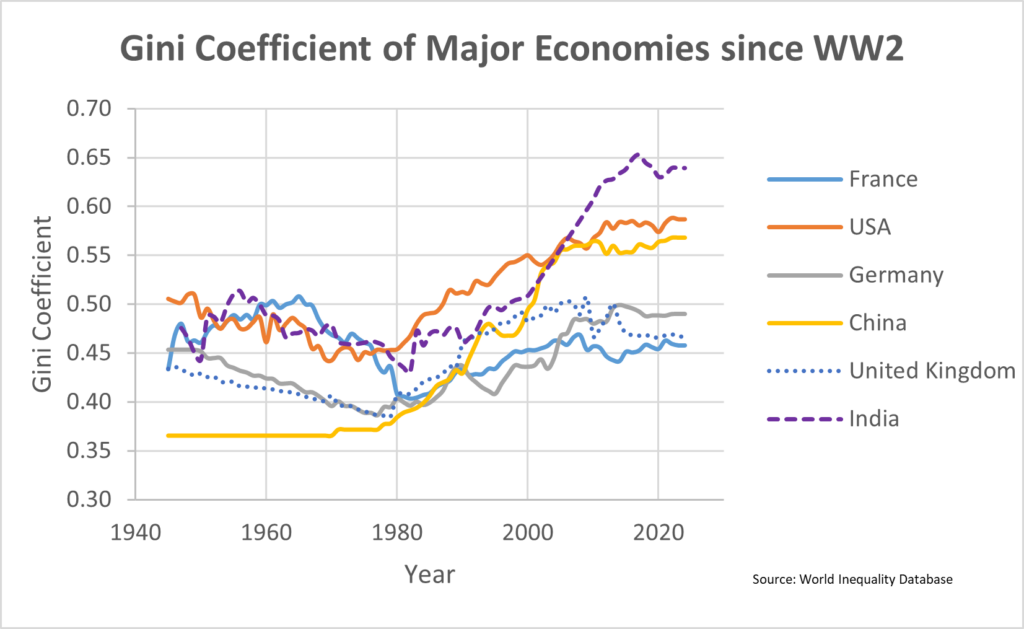
The injection of cheap money came at a perfect time for tech capitalism, as the money inflated tech companies’ share prices immensely, leading to substantial capital gains. While companies such as Meta (then Facebook), Alphabet and Amazon were already somewhat established before the financial crisis, they ballooned through the injection of cheap money. These companies were able to invest large sums into infrastructure such as cloud farms, using their value on the stock market as financial leverage (mind, that these companies were not profitable then). They, hence, managed to build an empire without profit, ultimately amassing power and money in the hands of a few large players who capitalised on central banks’ craze to save private banks. Thanks to a dysfunctional financial system and central banks handing out money for free to save commercial banks were technology companies able to amass the power and wealth which they have today, enabling them to become technofeudalists.
What is Technofeudalism?
Before the advent of capitalism, Europe was reigned by monarchs who ruled over fiefdoms. In a fief, a subordinate is granted the right to economically exploit the area in exchange for a portion of what they produce. The monarch, hence, generates a stable income in the form of rent and does not have to fear competitive pressure from other (market) players. Should subordinates not pay their rent in due time, the monarch would send thugs to collect that income. When the first industries spawned in Britain, this feudal structure was changed entirely through capitalism.
Under capitalism, the goal is to commodify as much as possible and maximise profit to gain a competitive advantage. Through capitalism, the ruling class’ (if it had not been replaced) main source of income changed from rent to profit. The larger industries became, the more financing was needed, for example from banks. As the capitalist industrial structure grew larger so did banks alongside with it, creating an industrial-financial structure in the span of some centuries. During the world wars, additional ties between this industrial-financial structure and the state were forged, ultimately intertwining both and leading to a co-dependency and co-development (some is also covered in my blog on Crude Capitalism). This led to revolving doors wherein the same type of people populate similar positions in private and public as well as public-private partnerships whose sole purpose is to keep the conglomerate alive. According to Yanis Varoufakis, this process created the technostructure which transformed the Western free market society into a centralised economy with markets. It is this technostructure which heavily builds on finance, technology, and state support which sowed the seeds of the crash in 2007/2008 and, ultimately, technofeudalism.
We are now in a process where the pendulum swings back to feudal structures because of tech platforms such as Meta (at large), Alphabet, and Amazon. Taking Amazon as an example, this conglomerate rules over a substantial fiefdom because of the cloud infrastructure it was able to create due to the free money from central banks. Vendors in Amazon’s fiefdom can regularly sell their products, but they need to pay a form of rent as a share of their profits. Should they not oblige, their punishment would be even more severe than a few hundred years ago when the lord would send some thugs. Amazon, as a form of coercion, can simply delist vendors and remove them from their platform which, by virtue of its substantial standing, translates into losing access to almost all customers. But a tech-fief is even more intrusive than a fief from the past. In Amazon’s fiefdom, everything on the market either belongs to Amazon or is regulated by it. Two people will have entirely different experiences with the market, as the algorithm changes what you see depending on what the optimisation algorithm curates for the individual. Whereas two shops on the street can compete under market conditions in a market setting, in Amazon’s fiefdom, the shops are dependent on Amazon’s goodwill. The only thing Amazon needs to do is collect their rent. This is what technofeudalism according to Yanis Varoufakis is, a system wherein techplatforms own the entirety and generate huge rent devoid of market mechanisms.
Technofeudalism Alienates and Stratifies People
A direct result of technofeudalism is a stratification between workers and customers who suffer from similar alienation processes. Workers are reduced to cloud proles who are getting instructions and supervision from computers for tasks which machines are not able to perform at the moment. Customers, on the other hand, perform free labour for cloud platforms by feeding information into their advertisement trackers through their usage of the platform.
Think of the Amazon worker in the warehouse, who day in and day out sorts packages based on instructions from the computer system. The worker does highly specialised and repetitive work in an isolated setting, completely decoupled from the rest of the package delivery process. On the other hand, the customer is lured by technofeudalists into their marketplace and manipulated by algorithms to buy products. Shortly after pressing the buy button on their platform, a package magically arrives on the doorstep. Another example is food delivery, which now, too, is managed by technofeudal lords. In this case, the delivery driver is the cloud prole and has to sell their labour for barely enough to survive. As customers, we again enter the magical world of technofeudal lords and are completely alienated from the process of food preparation and delivery. The delivery person for us is just a cog in the machine and dehumanised, so much so that we get shocked when we see that the delivery has a fee attached to it. The key consideration here is that people who buy and operate in these platforms are completely alienated from the remaining process and their human environment. The distance between both sides leads to stratification between the worker and the customer. People’s lack of understanding of how the platform operates and what other people in the process have to go through leads to alienation. Stratified and alienated people are easy to manipulate.
Technofeudalism leads to Totalitarian Control
With just a few technology companies taking control of the world markets, privately owned corporations slowly become the owners of the world. Technology companies have the ability to dictate what gets sold where and when at what price. Of particular concern is how technology companies’ might gets accentuated with globalised financial markets. The globalised financial system gives technology companies the ability to exert pressure on governments, ultimately extending their dominance beyond their platforms. Private actors, hence, take control over formally sovereign countries. But it does not stop there.
Technology companies influence political life by taking control of communication systems such as social media. Technofeudal lords hold social media and its users hostage by controlling what they see, post, and interact with. Meta’s platforms have turned into active tools of manipulation and opinion fabrication, just as TikTok and Twitter. Hateful and racist content performs exceptionally well, whereas critical influencers are getting shadow-banned or completely removed from their platforms. Technofeudals political influence is so significant that modern day electoral campaigning is unimaginable without adequate social media strategies. As such, political parties spend enormous sums to influence public opinion via social media campaigns. An extreme example is the corporatist USA, where the likelihood of a candidate winning is determined by the amount of their marketing budget.
What is particularly worrying is the steep rise in fake news and troll accounts usually embedded in the neo-fascist discourse. There are countless companies whose sole purpose is to spread far right propaganda. A hub for such political influence can be found in the alleged technology nation Israel, which is infamous for hosting companies which poison public discourse through far right propaganda (read how Israeli and US networks manipulated the election in Honduras and other countries). With the rise of artificial intelligence, people can create fake influencer accounts who support certain political agendas. That this can even be exploited commercially was recently shown by an Indian medicine student who made ten thousands of USD by creating a fake far right influencer account.
The discourse often suggests that the state or ‘politics’ are victims of those technology companies. However, the evidence shows that the opposite is correct. States across the world are currently embracing tools which have been created by technofeudal lords. These tools give states the power to ramp up their policing, censorship, and exclusion of unwanted opinions. As such, protesters are increasingly becoming targets of digital repression by the state. Companies such as Palantir provide the police with tools which enable them to mass surveil citizens, predict crime through racial profiling, and supress any dissent from the outset. Drones and artificial intelligence technology which has been perfected in the Ukraine war and the genocide in Gaza is already used by police forces to fight protests. It is only a matter of time until all aspects of our existence can be controlled by the state.
The fact that greater shares of our lives can be controlled by the state is particularly concerning given the current fascist turn which is unfolding in the world. With fascist governments being able to control their citizens, their hateful and destructive agenda can be pursued easily at the ultimate benefit of technology-financial-state superstructure. We are nearing an Orwellian future, in which resistance and change from the bottom will be rendered almost impossible. We need to act now while there is still some civil space left.
What can we do about it?
The technofeudalist story does not unfold automatically with a clear goal on the horizon but emerges from the struggles and political battles we (don’t) fight in the here and now. This means that despite the shrinking civil space, people still have the capacity to change course and reclaim their ownership of the technologies which are increasingly being used to control them. We therefore have a number of options to gain back sovereignty and reclaim ownership of our economies.
The most foundational but crucial goal would be to get organised in groups. One of the biggest achievements of neoliberal capitalism and technologisation is the atomisation of people, with individualism being a particularly present ill in Western societies. Atomised individuals are easy to manipulate, exploit, and supress, which erodes any form of resistance from the outset. By being organised in groups with clear goals and commitments, people are in a better position to enact change due to the power of the many. This also gives them the opportunity to seek and provide help should need be and be less vulnerable to exploitative behaviour. Additionally, people who are organised are less exposed to external manipulation as their intellectual exchange with others would strengthen their worldviews. This means that getting organised in groups is the most foundational strategy to pursue when initiating any change.
Power cannot be reclaimed simply by organising but it has to be seized through various forms of struggle, such as protest, boycotts, and other forms of civil action. These battles have to take place in the real world, but the digital can be used as a tool to mobilise and raise awareness. It is clear that censorship and other forms of coercion will take place on digital platforms, but with a sufficient mass of people, these barriers will be overcome. It may be difficult to organise a sufficient number of people for mass protest without an external impulse or shock, so we may need to wait when the time is ripe. However, the time should not be wasted but used to continuously mobilise and build the networks which we will need once larger protests erupt. We may need to wait for another Occupy Wall Street moment, but we need to be prepared for that moment in order to leverage it.
There is no doubt that some of the technology platforms can be used for good and can have societal benefits, but they are currently misused by the powerful on purpose for their agenda. Hence, one central goal of these battles would be to regain control and ownership of the tools which are currently in the hands of a few. The control, however, cannot be given to the state, as they can easily misuse them for their purposes. So control needs to be handed over to the people, alongside the ownership. But taking control over platforms may not change much if the operating logic of the platform does not change too. Hence, at the same time, we need to break apart most platforms into smaller units, as their integrated structures is often what gives them their insurmountable power. These smaller units which are controlled by the people need to fall under strict regulation and decommodify, for example banning advertising and data harvesting.
Our battles should not be restricted to the technological sector but target others too, such as the financial sector. The current internationalised and liberalised financial system is one of the key reasons why change in the current world is not possible. Without targeting the financial sector through similar measures as with technofeudalists’ platforms, the impact on national economies would be too severe in case of mass civil action and inhibit transformative change. Targeting the financial sector also means restricting capital flows, exiting international financial systems, and regaining ownership of national currencies. Without adequate financial and monetary change, technofeudalists will be kept alive by their financial friends.
Technofeudalism need to be Overcome in the Here and Now
Technofeudalism means nothing less than losing ownership of our life and societies becoming subjugated to totalitarian control by a techno-financial-state superstructure. Technofeudalism is currently evolving from a concept into a reality. We can already observe the first effects of the new economic paradigm, and the fascist turn fuelled by the AI wave will make matters worse. As I have outlined in this short piece, we cannot let corporates, financial markets, and states decide what should be done with digital technologies. Power needs to be taken by the people for the people. By reclaiming ownership over our real and digital worlds, our societies can flourish and use technology for societal advancements. For that we need to take action in the here and now.
Leave a Reply