By Ivo Wakounig
The 2020s seem to be shaped by a sequence of one crisis after the other. Geopolitical turmoil is heading the news and there seems to be no end in sight. A key contributing factor to the never ending state of emergency are the war-related events and mass killings of the past years. The genocide in Palestine, the illegal assault on Iran, or the war in Ukraine are just a few examples which capture our attention and reshape the world order which has existed over the past decades. Many people are murdered or lose their livelihoods as a result of the crises, as we can see from the ruins of Gaza. For most, the crises are a reason for despair, for some, a source of change. But what if all these events which I have listed are not crises but the operating logic of something much deeper?
This question was triggered when I read and reflected on Tim Di Muzio’s (2015) ‘Carbon Capitalism – Energy, Social Reproduction and World Order’. In this book, Tim Di Muzio dives deeper into the mechanisms and origins of carbon capitalism and how it shapes our world. Carbon, such as coal, oil, and fossil gas, is one of the defining features of modern capitalism by fusing energy provision, financial markets, capitalisation, mass violence, and social reproduction. It is one of the main goals and means which shape geopolitical developments and why various actors engage in warfare, colonialism, and repression. As this concept can help us understand the deeper dynamics which are at play, in this blog, I will summarise the core messages of the book, followed by a reflection on how it manifests in current geopolitical affairs. By that we will understand that the current geopolitical turmoil is not a world in crisis but rather carbon capitalism working as planned.
Carbon Capitalism is a System of Power
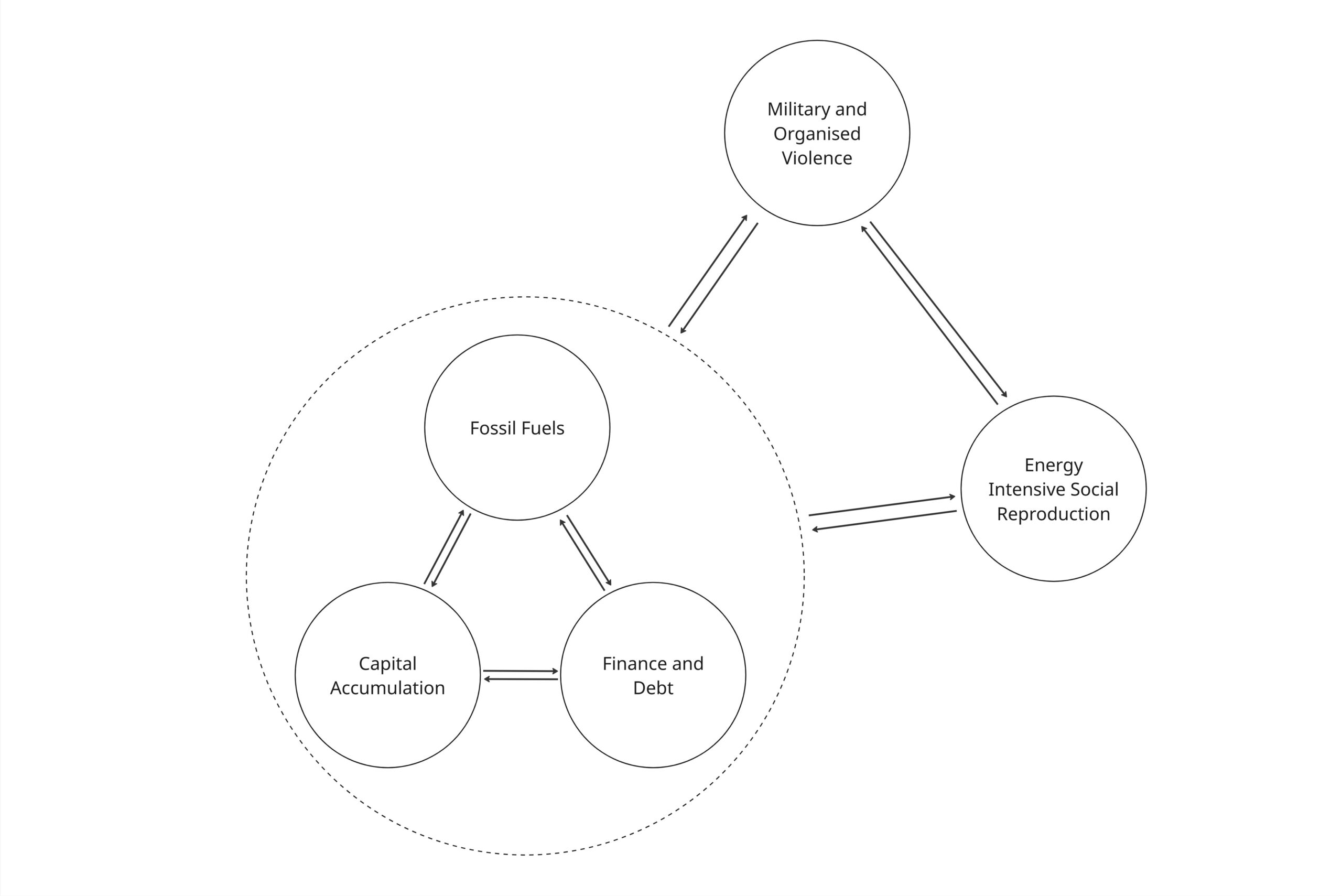
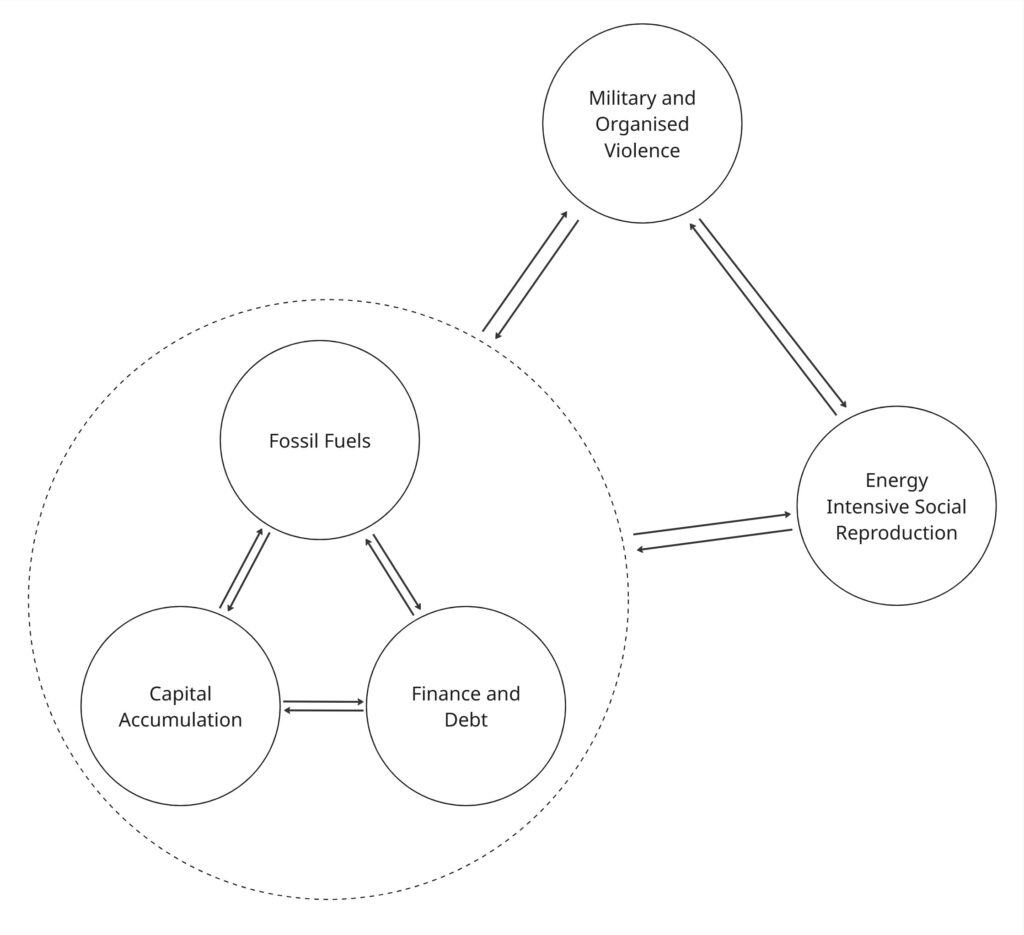
In an economic system shaped by carbon capitalism, the access to abundant and cheap fossil fuels enables capital accumulation and high energy-intensive forms of social reproduction. The capitalisation of fossil fuels is enabled through new money from debts. With fossil energy infrastructure being capital intensive, debt, money, and high energy social reproduction go hand in hand. For example, a coal power plant requires substantial amounts of capital, provided by banks which issue new money through debts. The owner needs to recuperate that investment by selling the energy to customers with a preferably high energy use. As the owner needs to pay back the debt with the interest rate, they need to maximise their profits, for example by promoting high energy demand. When investors purchase income-generating assets such as a coal power plant, the power over these assets is capitalised to influence the social reproduction, which increases the earnings. Due to investors’ need to capitalise on investments, capitalisation goes hand in hand with higher energy consumption. Hence, fossil fuels, capitalisation, finance, and high energy consumption are highly intertwined, leading to reinforcing dynamics. Higher energy consumption, capitalisation, and earnings increase differential power, which can be used to define societal relations and social reproduction. This power imbalance is enforced through violent means with the support of finance. It is because of these entanglements that higher energy usage due to fossil fuels tied to capitalisation and financial markets leads to higher power through violent means, through which control over the social process can be exerted. These relationships lead Tim Di Muzio to the interpretation that carbon capitalism is a system of power. This intertwined development is, however, not accidental but the outcome of a multi-century process to which I will attend to in the following chapter.
Carbon Capitalism has its Origins in Britain
Britain, the textbook example of a country undergoing the capitalist transformation, used to be ruled by kings who owned the land together with the clerical class and other tenants-in-chiefs. Land was highly concentrated in the hands of a few and the king had the sole right to mint money. This money was almost entirely used to wage wars, so kings were in constant need for money. Access to capital, power, and organised violence, hence, worked hand in hand. In the 1500s, competitive pressure to produce and monetise increased during a time when land enclosures abolished customary rights people had over working the land. This led to mass pauperisation, a depopulation of the countryside, and mass urbanisation, as people had to sell their labour for wage in cities. The stage was set for power relations and social reproduction in the following centuries.
When coal started to emerge as an important energy carrier, merchants were quick to take up monopoly positions by controlling the entire value chain. This was one of the first manifestations of carbon capitalism as power and this power position was used to strengthen the role of coal in the centuries which followed. Despite the emergence of coal, the state was still in need for continuous access to gold and silver to wage wars. To gain access to larger amounts of gold and silver, Britain’s strategy was to fuse the state, militarisation, and private capital, for example through joint stock companies. Joint stock companies such as the Royal African Company were created to mine gold and silver from Africa. However, once their expected profits did not realise, they turned to slave trade, shipping millions of people under inhumane conditions across the Atlantic Ccean. These slaves were used in the Americas as cheap labour on farms in the new colonies. Britain’s control over the shipping of slaves and goods was contingent on its ability to have access to coal, enabling it to wage warfare in the pursuit of larger profits. Slave trade was, hence, catalysed through coal.
United States of America Inc.
Another area where joint-stock companies acted on behalf of Britain was the colonisation of Northern America. Settlers laid foot on the continent as joint-stock companies were looking for land to derive profits. As large parts of Northern America were covered in forests and populated by indigenous tribes, there was a double challenge of clearing the land and getting rid of the native population. Clearing the forests represented an opportunity for profit, as the wood was used in the construction of colonial settlements and energy provision. Indigenous populations were subjugated by killing millions through disease and pushing the remaining populations in debt circles, forcing them to abandon their land for colonisers. Large shares of the land were given to soldiers as a reward for their service, which many resold at a discount to wealthy landowners, such as George Washington. Landowners’ differential wealth came from obtaining cheap land and growing cash crops with cheap labour. Hence, the double challenge of clearing forests and getting rid of indigenous tribes led to capital accumulation in the hands of a few through processes of ecocide and genocide.
In the second half of the 18th century, tensions between the colonial population and the British state rose, as the state wanted to raise taxes and stop westward expansion. In 1763, a Royal Proclamation made it illegal to settle west of the Appalachians and recognised indigenous rights to the land, as many tribes helped the British colonies win wars against the French in the north and the Spanish in the South. This infuriated colonisers, as this damaged their expected future profits, ultimately sparking the revolution from wealthy Virginians. The revolutionaries used the language of freedom and liberty, which was confined to limitless accumulation and never meant to apply to black slaves, who were forced to work the land for the profit of the colonisers. When Britain promised to free all slaves who joined their army, colonisers were infuriated even more, as they wanted to maintain their private tyranny over slaves.
The War of Independence Birthed US Carbon Capitalism
A major factor which contributed to revolutionaries winning the war was that investors financed military expenses due to the prospects of profits to be made from westward expansion. Capitalisation, military expenditure, and finance laid the ground for settlers’ success in their war of independence. After securing their independence, the United States of America was founded on principles of racial domination and endless accumulation. The constitution would safeguard that structure and the unequal distribution of property. The polity was designed in such a way that a minority could organise around issues and candidates while the state was dominated by a plutocratic senate. Policy in the US polity, hence, represents the interests of the powerful business elite in almost all cases.
In the newly formed state, slavery thrived in the south where agriculture was omnipresent. As farming was territorially expansive due to poor farming practices, farmers were pushed further south and southwest. In the north, people increasingly relied on coal for their social reproduction and the capitalisation which grew alongside it, rendering the large scale usage of slaves less important. Tensions between north and south increased in the decades following their independence due to issues pertaining to the different economic logics. This eventually led to the civil war in the early 1860s. With the north winning the war, a new form of capitalism emerged in the USA based on carbon energy and perpetual war. The civil war increased capitalisation which was financed by monetising state power, the social reproduction shifted from wood and muscle to coal, and the greater capacity to do work increased the money supply through credit.

Oil Deepened and Broadened Carbon Capitalism
Soon after the USA overcame its internal conflicts, the discovery and rise of oil raised carbon capitalism onto the next level. The construction of the extraction infrastructure led to the introduction of motorised vehicles and roads. This gave rise to the oil-automotive complex, deepening the relationship between fossil fuels, social reproduction, capitalisation, and, ultimately, war. This complex enabled the USA to monetise their oil in World War 1, turning the country from a net creditor into a net debtor (How oil reshaped the world can be read in another piece on Crude Capitalism). World War 2 and the decades which followed further entrenched oil (and fossil fuels in general) globally. The petrodollar, which replaced the Bretton Woods system, leads to continuous demand for dollars and is a direct result of the US military’s ability to project its military force onto the world. Hence, the US’ position as the leading military power go hand in hand with its control over fossil fuels and social reproduction. The weaponisation of the dollar and control over global social reproduction is accentuated by entanglements between the World Bank, IMF, and the US treasury, which puts many countries in the Global South into debt spirals. These debt spirals are accelerated during times of conflict. For example, the first oil crisis caused debts in the Global South to increase from USD 64 bln in 1970 to USD 376 bln in 1979.
These are only some of the key moments in the past decades which laid the foundation for enmeshing capitalisation and financialisaton, fossil fuels, and warfare. The USA, today, builds on an unsustainable, hierarchical, and environmentally disastrous form of social reproduction at home while encouraging permanent warfare abroad, with severe implications for geopolitics today.
The Current Crises are a Manifestation of Carbon Capitalism
Carbon capitalism has been built in the span of some decades primarily in the Anglo-Saxon context. There was no clear plan from the outset to create the structure in which we live in, but the connections and mechanisms have been built on purpose in the span of a few centuries. Today, carbon capitalism lies at the heart of our societies and large parts of the world operates according to its logic. The uneven access to energy, money, and political power is not normal but a direct outcome of differential accumulation giving the wealthiest privileged access to violent and institutional forces.
The ever-lasting crisis is the modus operandi of carbon capitalism in the 21st century. The climate crisis, socio-ecological breakdown, and continuous warfare are all tied to fossil fuels and the need to capitalise on fossil fuels assets by wielding power. Since the USA started its ‘war on terror’ at the beginning of the 2000s, the entanglements between fossil fuels, capitalisation, military, finance, and social reproduction took perverse shape. From the wars on Iraq, Afghanistan, Libya to the continuous bombardment of Somalia and military interventions in West Asia and Latin America, we can observe that the constant warmongering benefits a tiny few. The geopolitical events of today point towards an accentuation of the existing trends with uncertain outcomes. Here I will shortly outline how US carbon capitalism manifests in the war in Ukraine, in the Israeli genocidal settler colonial project in Palestine, and the war on Iran.
War in Ukraine
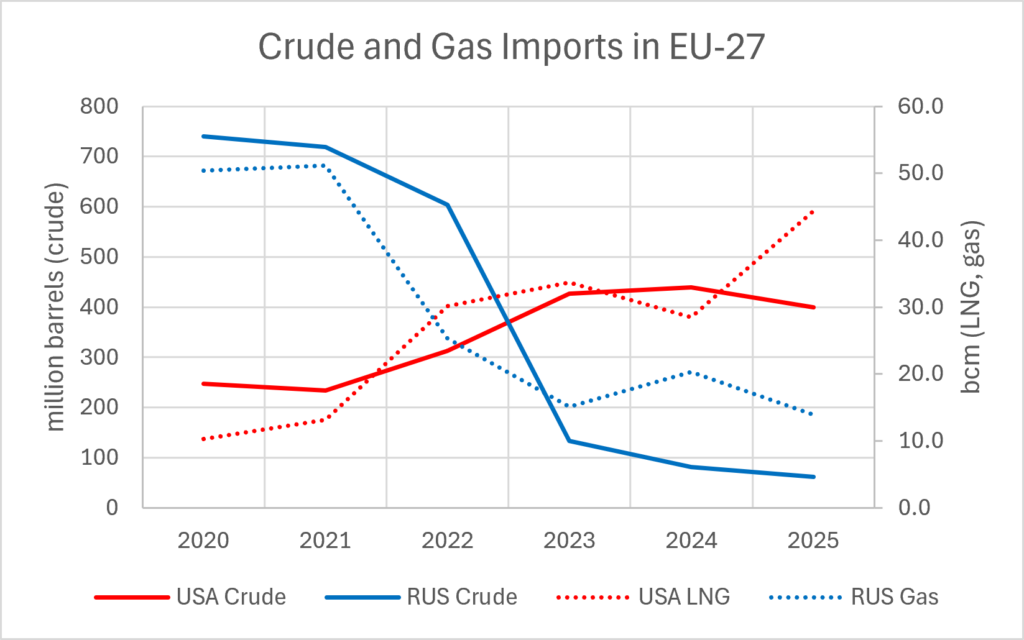
The war in Ukraine has profound impacts the geopolitical fabric. What seemed to be a quick victory for Russia turned into a stalemate with unpassable frontlines resembling those in World War 1. The impact of the war on energy markets was severe, as fossil gas prices in Europe skyrocketed in the first months of the war. The Ukraine war gave the USA the unique opportunity to replace Russia in European energy markets. Between 2020 and 2025, EU LNG imports from the USA increased from around 10 to 44 bcm, whereas crude oil imports increased from 247 to 400 million barrels. Importing costs from the USA increased from EUR 11.75 bln (crude) and EUR 1.87 bln (LNG) in 2020 to EUR 32.06 bln (crude) and EUR 24.54 bln (LNG) in 2025 – an increase in expenditure of 173% for crude and 1214% for LNG. At the same time, the USA subsidised its arms industry by suppling the Ukraine with dollars and secured access to large parts of its land for future mining activities. Hence, the war in Ukraine cemented the US position in Europe and continues to be highly profitable for its fossil fuel industry, showing how the USA benefits from carbon capitalism.
Israel’s genocide on Palestine
Israel’s genocide in Palestine is another example of crude capitalism as play. Israel was founded based on the vision of a Zionist ethno-state and, since its inception, mimics US patterns of settler colonialism. Through the first Nakba in 1947 and the wars which followed, Israel cleansed large parts of the indigenous land to make space for settler colonialists from various Western countries. The current intensification of this genocide in Palestine through the annihilation of Gaza, the continuous ethnic cleansing in the West Bank, and the attempt to establish a Greater Israel by annexing land in Syria and Lebanon is the culmination of the previous efforts. The annexation of land leads to prospects for profit, for example through the construction of settlements, and is enabled through its militarised society. New technology companies in domains such as mass surveillance, misinformation, drone technology, and artificial intelligence create an ecosystem which benefits from greater militarisation, securitisation, and capitalisation. The continuous inflow of fossil fuels enables the establishment and maintenance of the Israeli military state. Through its geopolitical position, the USA can use Israel as an outpost for its geoeconomic interests in the region by sowing insecurity. Israel is, hence, a state which is strongly tied to the logics of carbon capitalism.
War on Iran
Tightly linked to the Israeli settler colonial project is the war on Iran. Ever since the USA lost their puppet dictator through the Iranian revolution in 1978, the country is subject to foreign interventions and sanctions. The goal of continuous US interference is to gain access to and control over Iran’s fossil resources and capitalise on those for the US’ fossil industry. The current ongoing war on Iran serves to establish larger USA-Israeli dominance in the region for their capital accumulation and financial gains. The USA arms and fossil industries belong to key profiteers from the war. The bombardments led to a severe depletion of the existing arms stock only to be replenished swiftly at a large profit. Furthermore, the blockage of the Strait of Hormuz led to one of the largest energy crisis the world has ever experienced. The spike in oil and LNG prices profited the USA, as it is the world’s largest producer for both. What remains is that the entire region has been rendered insecure and we will likely see new trade patterns emerge as a result of that, potentially even a decline in the importance of Gulf states in fossil energy trade which the USA will be ready to fill. It is still highly uncertain which changes lie ahead but the first signals point towards the direction that the USA benefited substantially through the war due to the logics of carbon capitalism.
The Current Geopolitical Environment is an Extension of Carbon Capitalism
Seen through the lens of carbon capitalism, the geopolitical turmoil of today is not a mode of crisis but the culmination of previous trends strengthening the already existing entanglements. How these events will impact geopolitical developments in the years to come is highly uncertain, but we can already see that societies across the globe become increasingly securitised, autocracies are on the rise, countries raise their military spending, and marginalised people are further squeezed. The value of reframing the current context from a crisis to the modus operandi of carbon capitalism lies in the ability to formulate responses. Crises tend to evoke reactionary responses, whereas analyses using concepts such as carbon capitalism allow us to act more strategically.
What We Should Do
Relying on fossil fuels for our social reproduction has detrimental consequences for our societies. Maintaining the current carbon capitalist structures leads to profound destruction through warfare and suffering among the population. Globally, we may soon hit peak food, water, health, capitalisation, and civil peace due to fossil entanglements. These will pave the way for grand conflicts about access to the remaining fossil resources. This means that we will have to counter the logics or carbon capitalism to not only reduce suffering in the present but to also enable flourishing in the future. Here I outline some actions which we would need to take to gain back collective control over our economies and energy:
- Defossilise by deploying renewables: A core task of overcoming carbon capitalism lies in getting rid of fossil fuels swiftly, most importantly coal, oil, gas. These energy carriers lie at the core of the carbon capitalist system and many of its dynamics would be severely impeded through such an action. Alternative energy carriers which can fill the gap would be renewables such as solar, wind, and geothermal. However, as renewable energy systems in a world shaped by carbon capitalism can quickly lead to Green Colonialism (read more about it here), this needs to be complemented with changes in social reproduction.
- Reduce energy throughput: A key tension when changing to renewables is that we would change from a stock restricted (fossil) to a flow restricted (renewable) energy system. As the current energy throughput due to our fossil dependence is unsustainably large, we would need to complement the defossilisation with drastically reducing the energy throughput. This would ease the shift towards flow restricted renewables and reduce the burdens of deploying renewables. Such a reduction of energy throughput would require novel forms of social reproduction and the reduction of inequalities. Restricting the energy wastage of the wealthy would be as important as reducing energy poverty through restructuring infrastructure.
- Retake ownership: As large parts of the physical capital are concentrated in the hands of a few, the ownership of large infrastructure segments would need to be taken back by the collective. As long as these remain in the hands of profit driven individuals and companies, they will always prioritise capital accumulation over collective wellbeing. Hence, retaking claims over infrastructure would be a key requirement behind restructuring it for a different social reproduction.
- Definancialise: As with every change process and as I emphasise in many other blogs (Crude Capitalism, Technofeudalism), the largest factor inhibiting any change in ownership relations is the international financial system. When people take sovereign decisions, capital flight and adverse macroeconomic effects are real concerns and may severely impede any attempt to design a system for sustainability. While I do not have the complete answer for how to design such a process, we need to dismantle this global financial system if we want to see real change happening.
- Demilitarise: The final important step which we would need to take is to demilitarise our societies by getting rid of arms companies and their infrastructure. Warfare is a key profiteer and enabler of carbon capitalism and an integral aspect of the totalitarian control over societies, as militarised societies become internally securitised, preventing any form of radical transformative change. All parties and nations would need to demilitarise, as the arms race can only be broken when all put an end to it.
Conclusion
Tim Di Muzio’s ‘Carbon Capitalism’ offers a valuable lens through which we can understand and analyse the discontents of today. It makes us understand that the geopolitical crises of today are tied to centuries of fossil fuel usage embedded into systems of war and domination. Carbon capitalism enabled the world’s imperial forces to transform the political world order in their favour by exerting dominance. Today, we find ourselves in a situation where the many socio-ecological ills of our time are caused by capitalisation, militarisation, financialisation, and an energy intensive social reproduction. The current geo-political environment which is shaped by relentless warfare, genocidal mass killings, and an increasing addiction to fossil fuels poses great threats to our collective wellbeing. The time is ripe to change course to ensure flourishing of all human beings. Overcoming the problems of today will require collective action across multiple fronts while building on principles of defossilisation, a reduction of the energy throughput, retaking ownership of our infrastructure, definancialisation, and demilitarisation.
Leave a Reply