By Ivo Wakounig
Policies are a crucial enabler of energy transitions. They can regulate activities, put a focus on issues, and steer investments. Most policy related discourse in the energy field is pre-occupied with designing and perfecting (usually market-based) policies to achieve a certain outcome. However, little attention is paid to the implementation of policy, post implementation impacts, and how future policy making is affected by it.
Policies change realities and contexts, impacting politics and future policy making. Therefore, policies which are implemented today affect policies which are implemented in the future. Policy feedback literature appreciates the connection between policy and politics, and how they affect each other. This literature underlines the importance of adequately and smartly designing policies so that they can affect future policies.
In this article, I dive deeper into the concept of policy feedbacks by building on academic literature. See this article as an introduction into policy feedback literature, which illuminates the most important themes and concepts. Be aware that all studies are embedded in Western contexts (authors and empirical examples). While I think that many learnings can be applied in non-Western contexts too, the general applicability of the literature can be limited.
What are Policy Feedbacks?
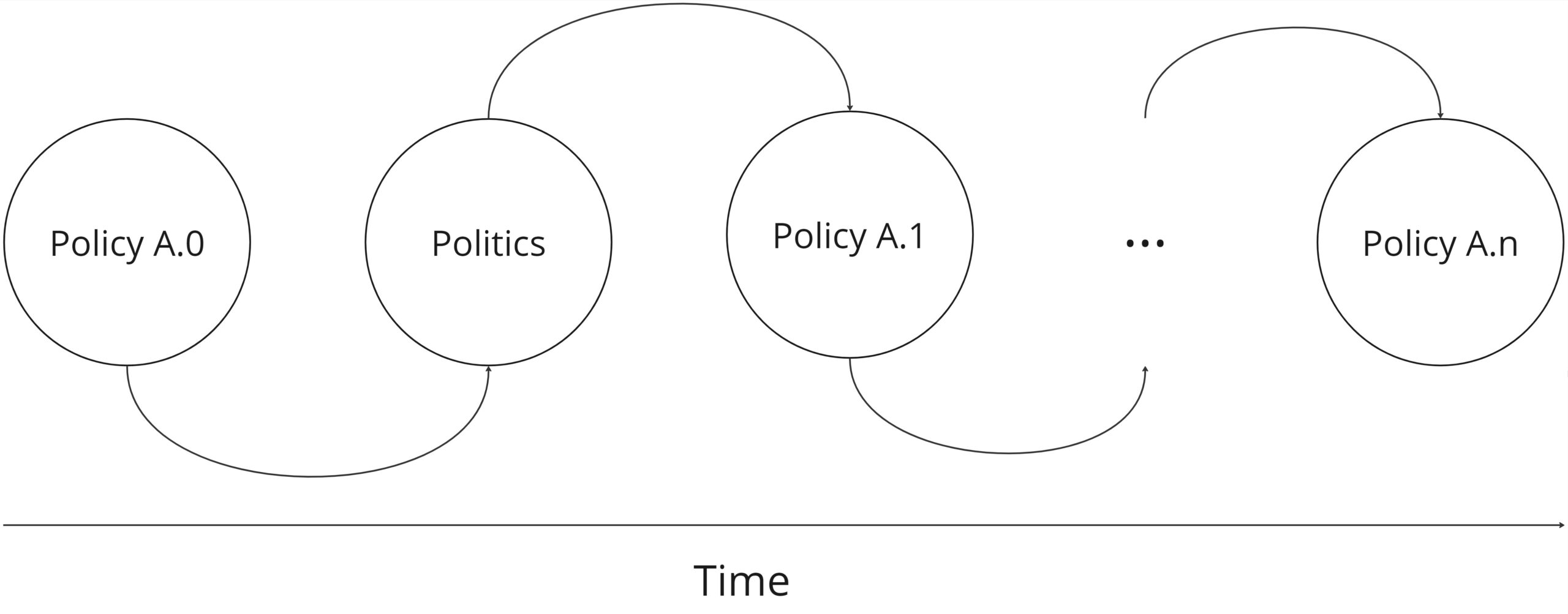
The starting point of policy feedback theory is that once policies are enacted, they affect political realities, which in turn impact subsequent policies (Pierson, 1993). Policies and politics are therefore intrinsically connected. Figure 1 shows a sketch of this relationship, wherein a policy in domain A is adapted over time due to the political changes it produces. When I talk about policy I follow Lockwood’s (2022) arguments to refer to policy mixes or policy regimes, because these concepts provide a broader account of the wider policy landscapes which are changing. However, for the sake of clarity, I use the term policy as a term which encompasses both.
In policy feedback literature, policy is both the starting and end point of analysis (Daugbjerg & Kay, 2020). Hence, policy’s impact on politics is the feed-forward effect, whereas we speak of policy feedbacks once policy is impacted again due to the political changes (Daugbjerg & Kay, 2020). Jordan & Moore (2020) define a policy feedback as a politically consequential effect operating via causal mechanisms affecting the original policy. Here it is important to differentiate between policy feedback effects and mechanisms.
Policy Feedbacks Effects
Schmid et al. (2020) define policy feedback effects as the impact policies have on subsequent politics. Policy effects can be positive or negative, thereby reinforcing or undermining the existing direction of policy (Daugbjerg & Kay, 2020). Béland et al. (2022) find six dimensions of policy feedback effects:
- Direction: the direction can be positive or negative (more about it later). In most cases, the effect is not dualistic but rather a spectrum.
- Strength: some policies can have a stronger / weaker effect than others.
- Timing and duration: the effect of certain policies depends on when and how long they are enacted.
- Scope: some effects can be narrow, whereas others can be rather broad and lead to spill-over effects into other policy subsystems.
- Traceability / visibility: the extent to which outcomes or changes can be linked to the policy.
- Intentionality: the policy effects vary depending on the intentions of those who created the policy. Most policy makers hope for policy expansion dynamics, but unintended consequences of policy may occur too.
Policy feedback effects are therefore highly variable and context dependent (Pierson, 1993). Policies may generate positive and negative feedback effects simultaneously, the balance of those effects can change over time, and they are in parts socially constructed (Oberlander & Weaver, 2015). The main categories of policy feedback effects are resource / incentive effects, interpretive effects, and institutional effects (Edmondson et al., 2019; Pierson, 1993), all of which lead to or are caused by different sets of policy feedback mechanisms.
Policy Feedback Mechanisms
Schmid et al. (2020) define policy feedback mechanisms as the process through which policies impact politics. Hence, the policy feedback mechanism is the process behind policy feedback effects. As with policy feedback effects the mechanisms vary in types and intensity and are not purely endogenous (Oberlander & Weaver, 2015). Categories of feedback mechanisms include (Béland et al., 2022)
- Increasing returns: increasing returns are caused by large set-up costs, learning and coordination effects, and adaptive expectations.
- Socio-political: socio-political feedback mechanisms are linked to constituency resources and power, and mass attitudes.
- Information, attention, and interpretation: this category includes the type of information which is received, elite attention, social construction, and menu contraction / expansion.
- Fiscal: this relates to whether a programme has an earmarked financing source and whether the financing of it can be crowded out.
- State capacity / administrative: this category includes feedback mechanisms which affect administrators, providers of policy, and lobbying organisations.
The effect of policy feedback mechanisms affects advocacy coalitions’ ability to push for their preferred policies (Schmid et al., 2020). Furthermore, the effects on politics can be manipulated by political leaders (Oberlander & Weaver, 2015). Therefore, while a variety of different feedback mechanisms exists, they are subject to high variety, lack of traceability, and conditionality (Béland et al., 2022).
Policy Feedbacks Dynamics
Policy feedbacks lead to dynamics, wherein policy and politics co-develop over time. For example, Edmondson et al. (2019) exemplify this relationship by developing a framework about the co-evolution of policy mixes and socio-technical systems. Policy feedback theory can also be combined with path dependence and transition pathways literature, helping analyse long-term political changes (Rosenbloom et al., 2019). These dynamics are highly dependent on the earlier feedback effects and mechanisms, most importantly positive / self-reinforcing and negative / self-undermining feedbacks.
If policy feedbacks are self-reinforcing, a policy would become more durable over time, whereas when the feedbacks are self-undermining, a policy would be removed or replaced by a possibly weaker policy (Jordan & Moore, 2020). Self-reinforcing feedback processes usually occur when they involve sunk costs and the creation of broad political coalitions, which lead to policy expansion, whereas self-undermining feedbacks can occur when policies’ logics are inconsistent and when solutions undermine rationales of other problems eroding actor coalitions which support this policy (Skogstad, 2017).
Political Sustainability
Self-reinforcing and self-undermining dynamics are important when it comes to the political sustainability of policies, in other words, how long and to what extent a policy is durable and ‘can survive’ multiple iterations (Jordan & Moore, 2020). To be politically sustainable (be aware that this is not a normative concept), polices need to maintain their integrity and functionality given different contexts and feedback effects and outlast the coalitions which enacted them (Patashnik & Weaver, 2021).
While it may seem that the durability of policy may be increased by having many positive and little negative feedbacks, this may lead to rigidity, making them difficult to adapt to new contexts, which creates tensions (Jordan & Matt, 2014). The goal should therefore be dynamic policy effectiveness (Béland et al., 2022), wherein policy revision mechanisms are in place which can correct policy design errors (Jordan & Matt, 2014; Jordan & Moore, 2020). Policies are hence more sustainable if they have strong positive feedbacks which strengthen advocacy alliances, but have sufficient negative feedbacks which can lead to enough contestation causing policy designs to be adapted as a response to those.
Policy Sequencing
Since policies can lead to backlash and resistance, sequencing policies smartly can lead to political sustainability of policy pathways. Policy sequencing is about implementing policies and making them more stringent in a way which takes into account the political dynamics. The timing of policy implementation influences their effect on the socio-technical system (Edmondson et al., 2019), and understanding policies’ political effects and their impact on advocacy coalitions helps influence their long-term dynamics (Schmid et al., 2020).
New policies, initially, need to build coalitions of change (Meckling et al., 2015), which maintain the support for government action (Meckling et al., 2017). This allows policies to be dynamically ratcheted up by slowly reducing stringency barriers (Pahle et al., 2018), increasing the likelihood of success for policy pathways. Successful policy sequencing needs to employ a mix of different types of positive feedbacks, which can help build coalitions and create incentives for change, but also have negative feedbacks which can correct pathways to respond to changing environments which can negatively impact their success (Lockwood, 2015; Patashnik & Zelizer, 2013; Weaver, 2010).
Policy Feedbacks and Energy Transitions
As policy is an important component in energy transitions, policy feedback mechanisms are central considerations in their success. For policy makers, it is critical to consider the co-evolution of policy and socio-technical system (Edmondson et al., 2019), allowing them to smartly design and sequence policies to maximise their political sustainability by locking in transition pathways (Lockwood, 2015). Politics, policy, and technological change are, hence, intrinsically connected in those transition pathways (Rosenbloom et al., 2019).
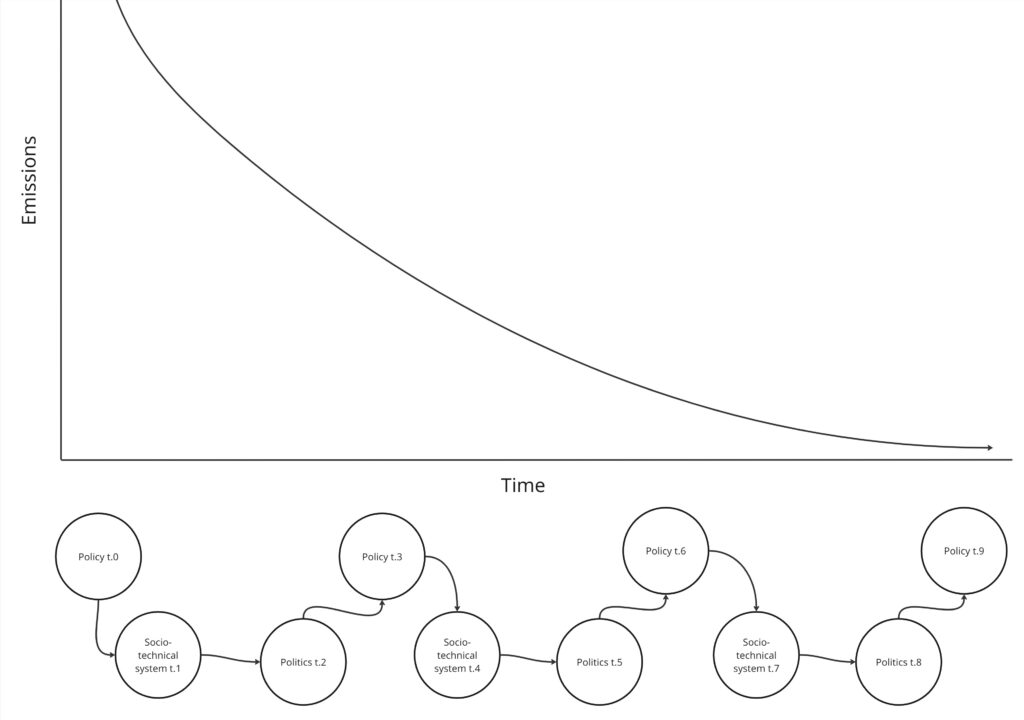
Meckling et al. (2015) show that successful green industrial policies need to enhance low carbon industries and build coalitions of change at the start by sequencing policies (illustrated in Figure 2). These industrial constituencies would then lobby for continuous support, tying governments to stricter emission reductions and helping ratcheting up climate action (Meckling et al., 2017). Such sequencing increase policies’ stringency by removing barriers found in the domains of economic costs, distributional dynamics, and institutions (Pahle et al., 2018). Policy strategies which can cut emissions while leveraging politics are (i) the adoption of targeted sector-specific policies to initiate a trend towards decarbonisation; (ii) sending high-leverage policy signals tied to concrete changes in industrial investments and production; and (iii) sequencing policies strategically while building and mobilising coalitions of change.
Conclusion
Policy feedback dynamics are a crucial concept which help us understand the political dimension of policy change processes. The concept has been applied to study various examples of political change processes. When designing policies which ought to contribute to transformative change, we should go beyond looking at their short term impact and goal and rather consider the dynamics which follow. The seeds of change for a sustainable future lie in following decarbonisation pathways which are politically sustainable and lead to long-term changes. Thinking in policy feedbacks can help facilitate that.
Literature
Béland, D. (2010). Reconsidering Policy Feedback: How Policies Affect Politics. Administration & Society, 42(5), 568–590. https://doi.org/10.1177/0095399710377444
Béland, D., Campbell, A. L., & Weaver, R. K. (2022). Policy Feedback: How Policies Shape Politics (1st ed.). Cambridge University Press. https://doi.org/10.1017/9781108938914
Béland, D., Rocco, P., & Waddan, A. (2019). Policy Feedback and the Politics of the Affordable Care Act. Policy Studies Journal, 47(2), 395–422. https://doi.org/10.1111/psj.12286
Béland, D., & Schlager, E. (2019). Varieties of Policy Feedback Research: Looking Backward, Moving Forward. Policy Studies Journal, 47(2), 184–205. https://doi.org/10.1111/psj.12340
Birkland, T. A. (1998). Focusing Events, Mobilization, and Agenda Setting. Journal of Public Policy, 18(1), 53–74. https://doi.org/10.1017/S0143814X98000038
Cairney, P. (2016). The Politics of Evidence-Based Policy Making. Palgrave Macmillan UK. https://doi.org/10.1057/978-1-137-51781-4
Daugbjerg, C., & Kay, A. (2020). Policy feedback and pathways: When change leads to endurance and continuity to change. Policy Sciences, 53(2), 253–268. https://doi.org/10.1007/s11077-019-09366-y
Dryzek, J. S. (1983). Don’t Toss Coins in Garbage Cans: A Prologue to Policy Design. Journal of Public Policy, 3(4), 345–367. https://doi.org/10.1017/S0143814X00007510
Edmondson, D. L., Kern, F., & Rogge, K. S. (2019). The co-evolution of policy mixes and socio-technical systems: Towards a conceptual framework of policy mix feedback in sustainability transitions. Research Policy, 48(10), 103555. https://doi.org/10.1016/j.respol.2018.03.010
Geels, F. W., & Ayoub, M. (2023). A socio-technical transition perspective on positive tipping points in climate change mitigation: Analysing seven interacting feedback loops in offshore wind and electric vehicles acceleration. Technological Forecasting and Social Change, 193, 122639. https://doi.org/10.1016/j.techfore.2023.122639
Goss, K. A., Barnes, C., & Rose, D. (2019). Bringing Organizations Back In: Multilevel Feedback Effects on Individual Civic Inclusion. Policy Studies Journal, 47(2), 451–470. https://doi.org/10.1111/psj.12312
Jacobs, A. M., & Weaver, R. K. (2015). When Policies Undo Themselves: Self‐Undermining Feedback as a Source of Policy Change. Governance, 28(4), 441–457. https://doi.org/10.1111/gove.12101
Jacobsson, S., & Lauber, V. (2006). The politics and policy of energy system transformation—Explaining the German diffusion of renewable energy technology. Energy Policy, 34(3), 256–276. https://doi.org/10.1016/j.enpol.2004.08.029
Jordan, A. J., & Matt, E. (2014). Designing policies that intentionally stick: Policy feedback in a changing climate. Policy Sciences, 47(3), 227–247. https://doi.org/10.1007/s11077-014-9201-x
Jordan, A. J., & Moore, B. (2020). Durable by Design?: Policy Feedback in a Changing Climate (1st ed.). Cambridge University Press. https://doi.org/10.1017/9781108779869
Lockwood, M. (2015). The Political Dynamics Of Green Transformations. In M. Leach, P. Newell, & I. Scoones, The Politics of Green Transformations (1st ed., pp. 86–101). Routledge. https://doi.org/10.4324/9781315747378-6
Lockwood, M. (2022). Policy feedback and institutional context in energy transitions. Policy Sciences, 55(3), 487–507. https://doi.org/10.1007/s11077-022-09467-1
Meadowcroft, J. (2009). What about the politics? Sustainable development, transition management, and long term energy transitions. Policy Sciences, 42(4), 323–340. https://doi.org/10.1007/s11077-009-9097-z
Meadows, D. (2001). Dancing with Systems. https://donellameadows.org/archives/dancing-with-systems/
Meckling, J., Kelsey, N., Biber, E., & Zysman, J. (2015). Winning coalitions for climate policy. Science, 349(6253), 1170–1171. https://doi.org/10.1126/science.aab1336
Meckling, J., Sterner, T., & Wagner, G. (2017). Policy sequencing toward decarbonization. Nature Energy, 2(12), 918–922. https://doi.org/10.1038/s41560-017-0025-8
Nesti, G., & Graziano, P. (2024). The impact of policy legacies on the implementation of Citizen Income in Italy: A policy feedback perspective. Review of Policy Research, ropr.12608. https://doi.org/10.1111/ropr.12608
Oberlander, J., & Weaver, R. K. (2015). Unraveling from Within? The Affordable Care Act and Self-Undermining Policy Feedbacks. The Forum, 13(1), 37–62.
Pahle, M., Burtraw, D., Flachsland, C., Kelsey, N., Biber, E., Meckling, J., Edenhofer, O., & Zysman, J. (2018). Sequencing to ratchet up climate policy stringency. Nature Climate Change, 8(10), 861–867. https://doi.org/10.1038/s41558-018-0287-6
Patashnik, E. M., & Weaver, R. K. (2021). Policy Analysis and Political Sustainability. Policy Studies Journal, 49(4), 1110–1134. https://doi.org/10.1111/psj.12391
Patashnik, E. M., & Zelizer, J. E. (2013). The Struggle to Remake Politics: Liberal Reform and the Limits of Policy Feedback in the Contemporary American State. Perspectives on Politics, 11(4), 1071–1087. https://doi.org/10.1017/S1537592713002831
Pierson, P. (1992). “Policy Feedbacks” and Political Change: Contrasting Reagan and Thatcher’s Pension-Reform Initiatives. Studies in American Political Development, 6(2), 359–390. https://doi.org/10.1017/S0898588X00001012
Pierson, P. (1993). When Effect Becomes Cause: Policy Feedback and Political Change. World Politics, 45(4), 595–628. https://doi.org/10.2307/2950710
Rempel, J. L., & Dobbin, K. B. (2024). When “symbolic” policy is anything but: Policy design and feedbacks from California’s human right to water law. Policy Studies Journal, psj.12564. https://doi.org/10.1111/psj.12564
Rosenbloom, D., Meadowcroft, J., & Cashore, B. (2019). Stability and climate policy? Harnessing insights on path dependence, policy feedback, and transition pathways. Energy Research & Social Science, 50, 168–178. https://doi.org/10.1016/j.erss.2018.12.009
Schmid, N., Sewerin, S., & Schmidt, T. S. (2020). Explaining Advocacy Coalition Change with Policy Feedback. Policy Studies Journal, 48(4), 1109–1134. https://doi.org/10.1111/psj.12365
Schmidt, T. S., & Sewerin, S. (2017). Technology as a driver of climate and energy politics. Nature Energy, 2(6), 17084. https://doi.org/10.1038/nenergy.2017.84
Sewerin, S., Béland, D., & Cashore, B. (2020). Designing policy for the long term: Agency, policy feedback and policy change. Policy Sciences, 53(2), 243–252. https://doi.org/10.1007/s11077-020-09391-2
Simoens, M. C., Fuenfschilling, L., & Leipold, S. (2022). Discursive dynamics and lock-ins in socio-technical systems: An overview and a way forward. Sustainability Science, 17(5), 1841–1853. https://doi.org/10.1007/s11625-022-01110-5
Skogstad, G. (2017). Policy feedback and self-reinforcing and self-undermining processes in EU biofuels policy. Journal of European Public Policy, 24(1), 21–41. https://doi.org/10.1080/13501763.2015.1132752
Sterman, J. D. (1994). Learning in and about complex systems. System Dynamics Review, 10(2–3), 291–330. https://doi.org/10.1002/sdr.4260100214
Vormedal, I., & Meckling, J. (2024). How foes become allies: The shifting role of business in climate politics. Policy Sciences, 57(1), 101–124. https://doi.org/10.1007/s11077-023-09517-2
Weaver, K. (2010). Paths and Forks or Chutes and Ladders?: Negative Feedbacks and Policy Regime Change. Journal of Public Policy, 30(2), 137–162. https://doi.org/10.1017/S0143814X10000061
Leave a Reply