By Ivo Wakounig
Anyone who is following the news can attest that the number of conflicts and wars has increased substantially in recent years. The wars in Ukraine, Sudan, the Congo, the genocide in Palestine, the civil war in Myanmar, and the United States’ warmongering in Latin America are just a few examples of violent encounters contributing to this rise. While all these examples have their own historical roots, developments, and dynamics, they all add to an escalating militarisation worldwide. Alongside we can observe a fragmentation of an alleged uniform world order which has been shaping international relations in the past decades.
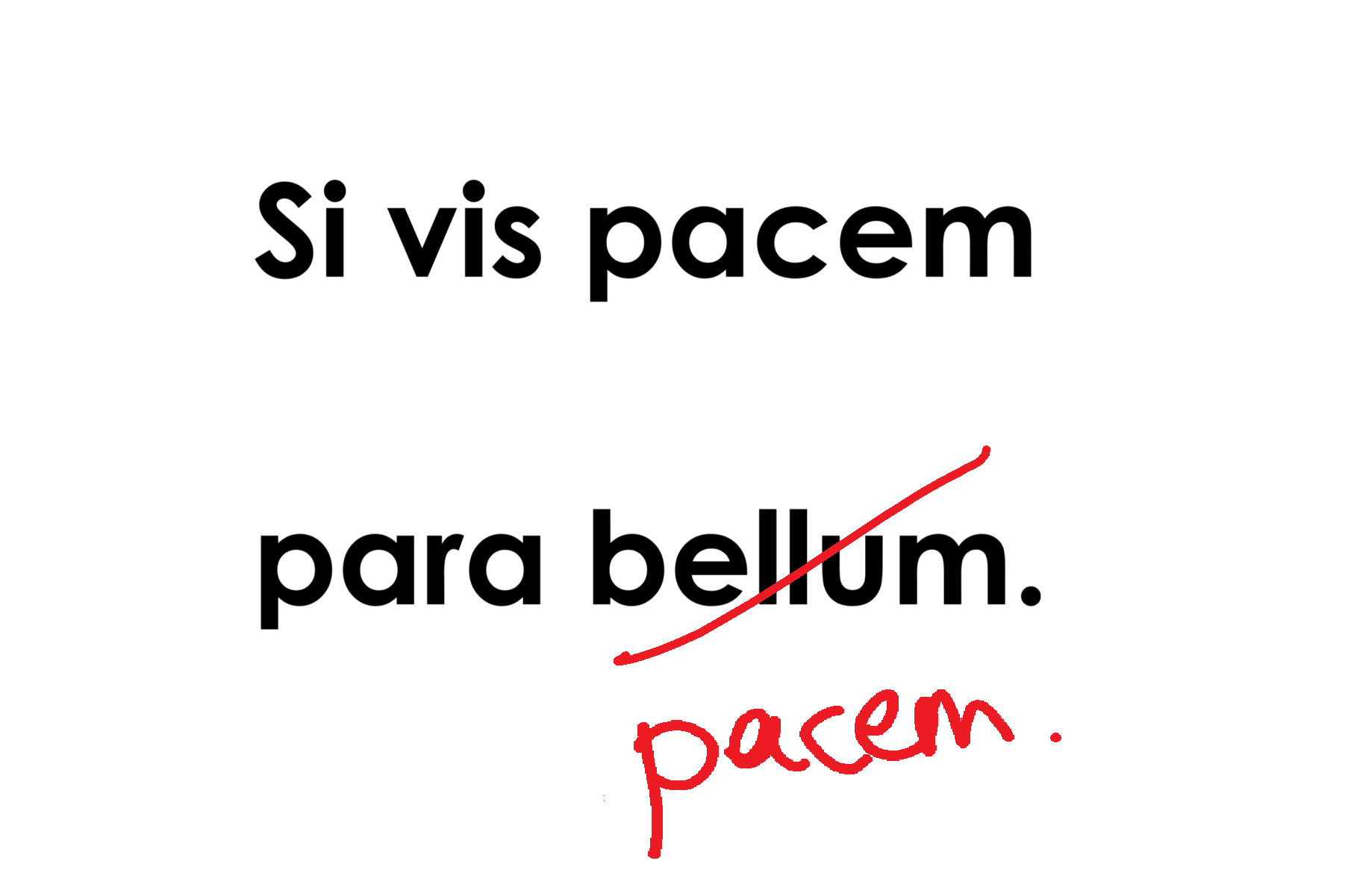
‘Si vis pacem, para bellum’
As a result of the rise in wars and fragmentation, more and more countries are increasing their military spending, pretending to want to protect peace. The militarisation efforts are sugar-coated by referring to Vegetius’ famous ‘Si vis pacem, para bellum’. This saying has become overused in recent times and it is being hijacked in Western contexts to justify increased military spending at the pretence of ensuring peace. Through such a narrative, incumbent powers normalise securitisation and militarisation, as if there were no other way to secure peace than through weaponisation.
The Roman Desire for Warfare
As a teenager I was quite fascinated by the Romans, their empire, and the ‘development’ they brought to great parts of Europe, Northern Africa, and West Asia. Looking back I feel that this fascination has almost been inevitable, as most of the games, TV shows, education, art, legislature, and even the monuments contained at least a few elements of Romanism. Caesar, for example, is portrayed as this great conqueror, shaping royal titles such as the German Kaiser or the Russian Zar. As Europe and the West in general are conditioned to adore Romanism and develop an admiration for the old Romans, it was only natural that I, too, was fascinated by the Roman way of life, their philosophies, and achievements.
However, only a few years after my school years I started understanding what Roman life actually built on: pillage, exploitation, injustice. The Roman empire has been imperial and expansionist from its very beginning, starting with the legendary abduction and mass rape of Sabine women. Famous Roman politicians such as Cato the Elder pushed for the eradication of their rivals (e.g, ending every speech with ‘Ceterum autem censeo Carthaginem esse delendam’ – Furthermore, I think Carthage should be destroyed), and Caesar’s glory came from mass killings and genocide in nowadays France and Netherlands. The pillage of great parts of West Asia and theft of agricultural produce in Northern Africa, coupled with the mass inflow of slaves were some of the components which kept the ‘civilised’ and ‘developed’ Roman empire alive.
Taking the Roman’s history of exploitation, pillage, and warfare into account, Vegetius’ ‘Si vis pacem, para bellum’ gets a very different flavour. On the one hand, it is a call for warfare and an eradication of alleged enemies to become the sole ruling force, as peace can only be achieved after war has led to the eradication of the enemy. On the other hand, on a much deeper level, the saying implies that for an empire, peace can only be maintained through continuous warfare. As internal peace in an empire can only be sustained through constant inflow of resources from its periphery, securing those resources through violent means becomes a core requirement to keep the empire alive. Hence, peace in an empire can only be maintained through continuous warfare and violent exploitation. By uncritically normalising the Roman empire as a beacon of glory and progress, the Western world normalised the Roman craze for warfare and pillage. And this has shaped European history ever since.
The Roman Way and the European War Fever
As the Roman way has been such a defining feature of the European continent, pillage, plunder, and subjugation have been infused into the European tradition of international politics. Centuries of conflict have shaped Europe to solve its internal contradictions through warfare. However, not only was the Roman way infused in European politics, but its empires put it on a next level by globalising it. This globalisation of plunder happened through colonising large parts of the world within a few centuries. This colonisation consisted of a combination of settler colonialism, where land is stolen from natives, such as nowadays USA or Australia, and resource colonialism, where resources such as gold, spices, and sugar are stolen from natives, which happened to most of the Global South. Both forms of colonialism were also practiced by the Romans, as soldiers received agricultural land in conquered territories after their service (settler colonialism) and regions such as North Africa became Rome’s breadbasket (resource colonialism). Colonialism is, hence, globalised Romanism. War and warfare are such a defining feature of European history, both at its core and at the periphery, that its expansionist Roman identity set the stage for both World Wars. The so-called Western world, hence, builds on the tradition to solve its contradictions by externalising warfare and plundering other countries. Rabindranath Tagore’s observation that ‘the West feeds upon the resources of other peoples and swallows their whole future’ summarises this dynamic very well.
European Peace Builds on Warfare at the Periphery
Only since a few decades are most countries in Europe at peace with each other, partly because of the European Union. However, this does not mean that European countries do not engage in warfare, as the military interventions in Afghanistan, Iraq, and Libya show. Hence, a great contributing factor to the European peace project is that conflicts have been ‘outsourced’ to other regions, and that the bulk of warfare has been done by its long-standing ally USA (think of the war in Korea, Vietnam, countless coups and military interventions in Latin America and Africa). In the past decades, the (domestic) European thirst for blood has been numbed, as the USA did the ‘dirty work’ for the continent.
The European population is misled by its leadership to believe that its successful peace project comes from its glorious society and identity. Just like the aristocracy in ancient Rome, the population in modern Europe is unaware that its internal peace is the result of external conflicts and exploitation. Post World War Two reconstruction in Europe would not have been possible without pillaging oil resources in West Asia and relying on cheap labour in Asia and Africa, which became a covert form of neo-colonialism. Only recently has this imperial mode of exploitation received its first visible cracks through the rise of China, leading to the many tensions we currently face. Instead of tackling the internal contradictions of the Western economic model, those contradictions are externalised through conflicts and warfare.
Offence is the best Defence
In the past years we have seen a radicalisation of Western discourse following the war in Ukraine, and the simultaneous withdrawal of the USA from the European security architecture. We can observe a steady and steep militarisation on the continent and deafening warmongering from political elites. NATO spending has increased substantially, countries such as Germany slowly re-introduce military service, and the entire media rhetoric is shifting towards escalating the ‘grand conflict’ with Russia (and potentially China in the future).
These are dangerous times for the world, not only because countries increasingly invest into arms while conflicts are on the rise, but also because Europe is re-entering the global battlefield. Particularly dangerous is that Germany (the successor of the military state Prussia) rediscovers its military potential, during a time when the political landscape shifts towards the right. We are currently arming Europe while heading towards a potential far-right leadership in a few years. History teaches us that it will only be a matter of time until governments will unleash their military might to solve their internal contradictions. Domestically, civil rights and other kinds of freedom will be under assault (as we can currently observe in entire Europe), internationally Europe will join forces with the USA to bring destruction to the world.
A Plead for Radical Peace
The current geopolitical context could not be more concerning. During a time when the world is faced with socio-ecological breakdown, major Western states turn their attention towards solving conflicts through warfare. Money is available to finance economically senseless goods such as arms, rather than investing into transitioning our energy systems. Not only does warfare lead to the decimation of entire populations and civilisations, but it has catastrophic effects for the environment too, due to greenhouse gas emissions, toxic waste, and debris. Overcoming our socio-ecological challenges will require a concerted effort from different societies and regions. This would build on genuine collaboration between different parties, mutual respect, and the pursuit of human flourishing.
In other words, we will need radical peace, which centres around peoples’ right to exist and self determination, upholding human rights, and refraining from the use of military force against others. Radical peace will not lead to the absence of conflict, it rather recognises that conflict can be a catalyst for progress when resolved through non-violent means. Radical peace can be achieved and maintained through functioning international institutions which overcome partial interests and embody a spirit of shared human progress. Radical peace is also about demilitarising, so getting rid of all forms of arms. As wars are fought when weapons exist, demilitarised societies find peaceful means to solve their conflicts. Radical peace, in other words, does not need a complete transformation of the global political order but rather a reinterpretation of how it is practiced and, most importantly, disarmament.
For Europe in particular, aside of demilitarising and rethinking their exploitative economic model, embracing radical peace would mean letting go of its Roman legacy and embracing more collaborative politics. Hence, to ensure human flourishing in the 21st century and beyond, we need to go beyond the European obsession for warfare and the Roman way of politics by embracing radical peace. Demilitarisation is the first step towards a future in which all peoples in this world can flourish. If we want to have peace in this world, we must build peace. Si vis pacem, para pacem.
Leave a Reply