By Ivo Wakounig
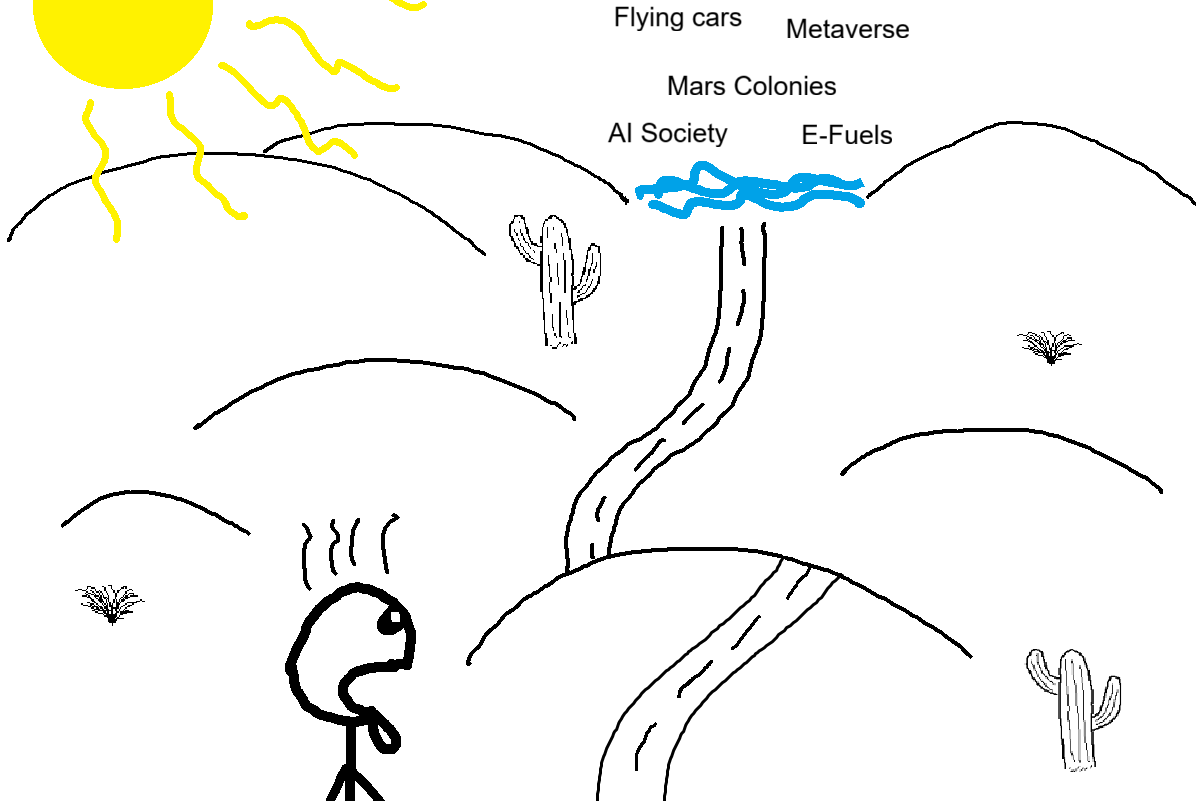
A fata morgana is an optical phenomenon distorting the image of distant objects, creating illusive and magical pictures. In stories and myths, a fata morgana usually stands for some mysterious goal which can never be reached, such as the ever so distant oasis in a desert.
Innovation has turned into one of the most overused buzzwords in contemporary debates. Whatever problem you may face, be it technological, economical, or societal, innovation will come to the fore and solve it for you. This issue is particularly omnipresent in dominant debates surrounding the climate crisis and energy transition, wherein innovation is seen as the perfect solution to not only solve the most pressing problems but also open up new avenues for economic growth.
However, what this narrative around innovation does is that it completely disregards the complexities and reasons behind today’s polycrises. Even worse, it shifts the focus away from the root problem towards some imaginary fixes. These imaginary fixes I call innovation fata morgana, as they trick us into believing that salvation is not far away from where we are right now and deflect us from understanding the root causes of our misery and problems in the here and now. The dangerous part behind this is that the innovation fata morgana seems to exert a group effect, wherein entire segments of the population are led into the false direction. People who are not being tricked by the false image are called backwards and behind, whereas the ones misdirecting others are hailed for their forward-looking leadership.
As climate and ecology crises are accelerating year by year, we cannot afford losing more time to false promises. We need to move towards transformative change and focus on the actions which can deliver it effectively. In this article I will dive deeper into the innovation fata morgana and outline a few avenues how we can go beyond illusions tricking our beliefs.
What is Innovation?
Many conflate innovation and invention, equating two distinctively different concepts. Invention is the creation of a new idea, while innovation is about putting this idea into practice. The novelty, which is usually implied in innovation, may not necessarily come from the idea but the process through which it is implemented. Putting a new idea into practice can be as innovative as finding new ways to use an old idea. So innovation can have multiple facets and dimensions, mainly concerned with new ways to make use of ideas. Innovation is not only restricted to the technical but can be extended to the societal and other sectors too, for example by thinking in terms of practices or worldviews.
Generally, innovation is considered to be a neutral concept which can summarise many topics under its aegis. However, it becomes value laden and political once innovation is used to advance a certain agenda – the procedural aspect is the key component here. On the one hand, innovation can accelerate transformative change if new ways of doing things manifest in different practices and outcomes. On the other hand, innovation is often misused as an illusive object to divert attention from the actual problem and, hence, prevent transformative change. This I call an innovation fata morgana.
The Innovation Fata Morgana
The innovation fata morgana is an illusive object which misdirects people by creating false or distorted images of an innovation’s future. By creating such false images of the future, these innovations misguide and trick us to seek the wrong solutions, essentially wasting precious time and resources. By drawing our attention to some mysteriously desirable distant objects, they divert the attention from the problems in the now, their causes and solutions.
Think of flying cars. Everyone who has ever been stuck in traffic knows the agony of being trapped in the same place, barely being able to move. Now add an urgent appointment to this scenario and you created the perfect environment for frustration and helplessness. In this moment, your sole desire is to escape as soon as possible, for example by simply lifting off your car and flying freely to your destination. This is the innovation fata morgana which is being portrayed by ‘innovators’ working on flying cars. Resources are being poured into developing such a car, ultimately painting a future where cars not only drive but also fly (!) through cities. Just imagine how our city land- and airscapes would look like. Not only will cars claim the majority of public space on the ground of the urban environment, but soon in the air too. Instead of discussing why and how we are again (!) stuck in traffic and starting debates on how to create functioning mobility systems, this fata morgana grabs our attention and directs it towards illusive concepts. This innovation fata morgana does not question the car centric mobility system but rather further entrenches it.
Another example is Mars colonies. Put forth by the wealthiest people on this planet, this vision seeks to send human beings to our solar system’s fourth planet and colonialise it. Central to this vision are large rockets to transport people and material, elaborate technologies to keep the people on Mars alive, and terraforming to create an atmosphere and arable land. These colonies shall save humanity (or should I say its elite) from the ills on planet earth by escaping during its decline. Aside from moral and logistical considerations, terraforming Mars by creating an atmosphere is not possible. Since Mars has an extremely feeble magnetic field, one solar storm would be enough to blow away an artificial atmosphere and expose its hypothetical inhabitants to hazardous levels of radiation. Hence, the resources which are being poured into this fata morgana are directly going to waste. As with the previous example, this innovation fata morgana diverts our attention to some illusive vision of the future and away from the real problems which we face on our home planet.
A final example is innovation itself. As the world is currently being struck by a multitude of crises, both in ecological and socio-economic domains, people are rightfully thirsty for answers and solutions. More and more decision makers, instead of critically inspecting what created the thirst in the first place, prefer to trick people by finding solutions in innovation, whatever it may mean. Innovations are supposed to fix the climate crisis, health issues, inequalities, political issues, and so forth. By turning innovation into this all encompassing salvation of all our problems, decision makers are able to mute any confrontation and genuine debate about fixing root issues.
As these examples vividly show, innovation fata morganas can have severe negative consequences by misdirecting us into some false imaginative future. By removing the focus from the structural problems in the here, they cement in the current state and worsen the situation we are currently living in. The innovation fata morgana, hence, has severe impacts on societies.
The Impact of Innovation Fata Morgana on Societies
Imagine yourself in a group of people, desperately trying to find water in the desert. Some people in the group are apathic, hoping to find immediate salvation to still their thirst. You know what needs to be done in that moment, as you know that only a few meters below the surface is an underground water cavern. Suddenly, one or two members of the group spot a fata morgana in the distant. A distorted image of a water body promises an immediate solution to your water problem. They excite the group about their findings and ask them to rush to the fata morgana. You, knowing that this is just an optical illusion distorting the group, try to convince the group to not follow the false promises and instead dig a few meters to find the desired water. Who do you think the group will believe?
This should exemplify one of the critical issues which is created by the innovation fata morgana. Since great parts of the population are in such pain and need of solutions, many can easily be tricked into going to the wrong direction. If you disagree with what can be seen on the horizon and rather ask others to do some extra digging in the here and now, many will struggle to listen to you and follow your advice. Unlike the fata morgana which can be seen by everyone, your alternative option requires extra efforts in the here and now, in this example digging a hole to access the cavern. The ones who are tricked are not listening to you because they are ignorant, but because they are desperate to find immediate relief. The ones to blame for directing the group to misery are the ones purposefully misdirecting others and leading the charge.
Taking a different perspective, we can transpose this fata morgana metaphor to current political economy debates. Under late stage (neoliberal) capitalism, which is the leading cause behind the current polycrises, the innovation fata morgana offers a convenient escape to evade conversations regarding the root causes of our problems. Our current economic system generates despair and anxiety among people, for example due to climate-ecological breakdown or rising inequality. Finding a way out is often unclear and riddled, and innovation, offering a supposedly quick and easy fix, represents a promising way out. Instead of addressing the root causes of our problems, people are tricked into believing that more technology can alleviate our problems, instead of restructuring the political economic system. The ones tricking societies with their false promises are called forward-looking and innovative, whereas the ones investigating the root causes of our problems are framed as backward. Because salvation can be observed just on the horizon, resistance from people questioning the fata morgana is easily erased, leading to further entrenchment of the status quo.
What Should We Do to Evade the Innovation Fata Morgana?
By now it should be evident that successful strategies to evade the innovation fata morgana revolve around people’s anxieties and struggles and the root causes behind those. This requires a critical and honest inspection of the drivers which cause the struggle and thirst in the first place and move forward from there. Such an inspection will be highly contentious and difficult, as various interests are at stake, first and foremost the ones profiting from the system design causing said issues. For example, investigating the root causes behind continuous traffic jams would mean questioning car-centric mobility systems, which are enabled through the interests of large players, such as the automotive industry. This step in itself would already lead to various struggles and conflict, however, it is necessary to provide a factual basis for where we are.
Another important strategy would be to expose the people pointing towards the fata morgana, many of which know that it is an illusion, and the fata morgana itself. This strategy is closely related to the first, but it targets actors exploiting the problem, many of which created it in the first place. Exposing the illusion requires an awareness of our current problems in the here which will inform our understanding of the mechanisms which are used to trick us. Furthermore, as there will be opposition, there needs to be a critical mass rallied behind this understanding, otherwise you will turn into a Cassandra-like figure in an attempt to warn others. Such a critical mass with sufficient knowledge will also help you win the political struggles against incumbents and contribute to transformative change.
A final strategy would be to provide space for care, compassion, and conflict. Realising that we have fallen for such tricks can be quite embarrassing for many, as their personal perception of their own public image would change. Most people may even take offense when their understandings or worldviews are getting shattered as they become very vulnerable and defensive (understandably so). Often, people prefer to stick to false narratives which they know are lies rather than going through the emotional pain of unlearning false beliefs. As this can become a great barrier for transformative change, there needs to be space for care, compassion, and conflict, in which such emotions can surface without judgement and attacks on the individual.
To navigate out of the current polycrisis, we will need different types of innovations. However, before following some innovation fata morgana in the distant, we need to take time to assess the current status and our conditions and move on from there. Only then will we be able to understand what kind of innovation we would need and how it can help us achieve prosperity. A society which endlessly wanders around the desert desperately trying to find a new solution cannot flourish.
Leave a Reply